
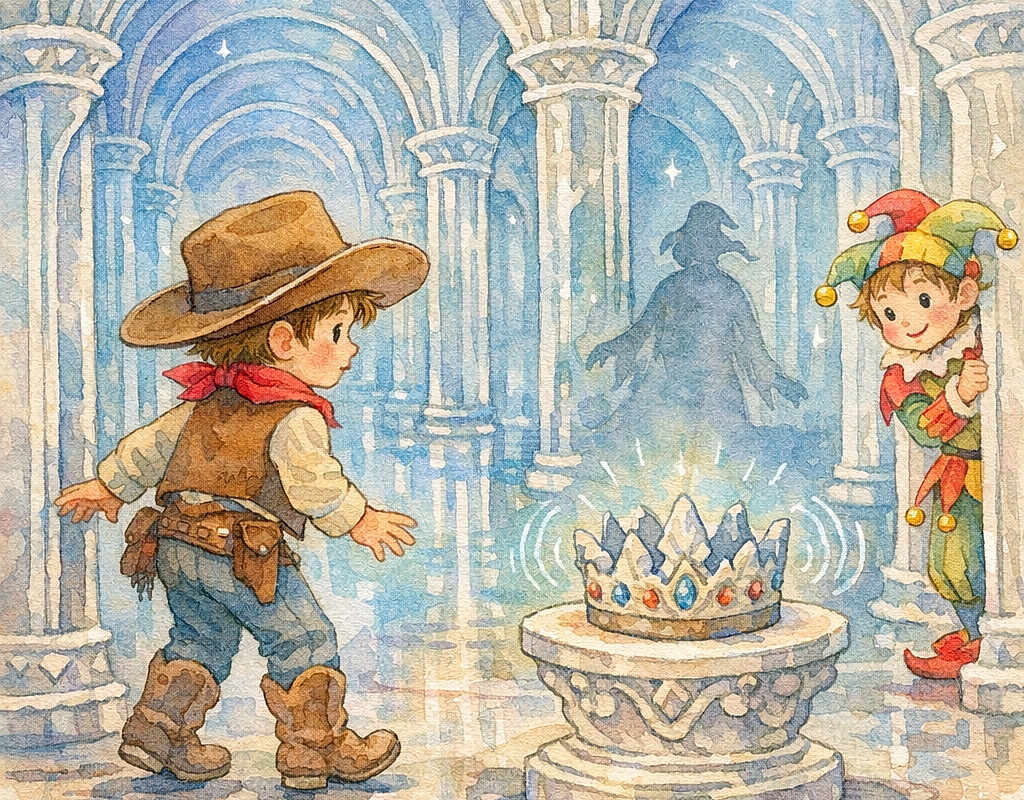
Luis had always thought a palace was the opposite of the Wild West.
A palace meant polished floors you could see your own boots in, curtains that looked like sunset clouds, and guards who stood so still they might have been carved from the walls. The Wild West meant dust that sneaked into your socks, fences that leaned like tired cows, and people who waved at you with hands that had actually done work.
So it was strange—almost funny—that Luis, a cowboy with a sun-faded hat and a lasso he’d braided himself, was walking through the Moonrise Palace as if he belonged there.
He didn’t.
But he also didn’t run from places that didn’t make sense.
Luis was the kind of cowboy who listened before he spoke, and who noticed things most people missed. Not just tracks in the dirt, but tiny changes in the air—like when a horse was nervous before it even stepped sideways. He had a steady courage, not the showy kind, and it showed most when other people panicked.
The palace was panicking.
Servants hurried like windblown leaves. A chandelier trembled, even though there was no breeze. Somewhere behind a door, a woman whispered a prayer and then shushed herself, as if her own voice might wake something.
Luis rested a hand on his belt and looked up at the painted ceiling. Stars and swans and golden vines twisted together. The vines seemed… darker than the rest, like someone had washed them with night.
A guard cleared his throat. “Cowboy Luis? This way.”
Luis followed, boots thudding softly on marble. He’d been invited by the palace’s steward, a stiff man who wrote letters like they were military orders. The letter had said only:
NEED HELP. SOMETHING STOLEN. SOMETHING HAUNTED.
Luis had read it twice, then once more, and finally said, “Well. That’s direct.”
He had packed his bedroll and his canteen and his best rope, and he’d ridden until prairie became road and road became city and city became walls that rose like cliffs.
And now here he was.
The guard stopped at a hall of tall mirrors. Each mirror wore a gold frame shaped like curling leaves. Luis could see himself repeated and repeated: hat, jaw, calm eyes, the small scar on his chin he’d earned by falling off a fence when he was ten and too proud to cry.
Only something was off.
In one of the mirrors, his reflection blinked a beat late.
Luis slowed.
The guard hurried away as if he hadn’t noticed. Or as if he had and didn’t want to talk about it.
Luis reached the end of the hall, where a door stood open to a room that didn’t match the rest of the palace.
It was a practice room.
The floor was scuffed. The curtains were tied up with knotted scarves. A half-collapsed stack of juggling pins leaned against a chair. A bright red suitcase sat open, spilling ribbons and face paint and something that looked suspiciously like a rubber chicken.
In the center of the room stood a clown.
He was tall and thin, but the thinness looked like it belonged to someone who moved fast and laughed a lot. He wore a coat patched with shining fabric, as if someone had stitched together pieces of different festivals. His makeup was only half done: one eye circled in blue, the other bare. His red nose—real, not painted—gleamed like a cherry.
When he saw Luis, the clown’s face broke into a grin that was not exactly cheerful.
It was more like relief.
“You’re the cowboy,” the clown said. “You have the boots and the ‘I’ve-seen-weird-things-and-I’m-still-standing’ eyes.”
Luis tipped his hat. “Luis. Folks call me cowboy because it’s easier than ‘the guy who can’t stay indoors.’ You’re…?”
The clown bowed so low his hat nearly fell off. “Basilio, at your service. Court clown, juggler, fool, professional tripping hazard.”
Luis glanced at the juggling pins. “You look like you’ve been practicing something besides falling over.”
Basilio’s grin flickered. “Practicing how not to scream. The palace prefers quiet fear. It’s more… elegant.”
Luis stepped further into the room. “Your steward wrote me about something stolen.”
“Stolen and not stolen,” Basilio said, and then clapped his hands as if to reset himself. “Come, come. Before you decide this is all nonsense and run back to your dusty horses. I’ll show you.”
Basilio led Luis through a narrow passage that seemed too small for a palace, like someone had tucked it away out of embarrassment. The air grew cooler. The walls became plain stone.
They reached a door made of dark wood.
Basilio hesitated. His cheerful energy shrank, like a flame pulled in by wind.
“Behind this door,” he said softly, “is the Hall of Echoes.”
Luis raised an eyebrow. “Sounds dramatic.”
“It is. It used to be a music room. Now it’s where the palace keeps the thing it doesn’t want to admit is happening.”
Luis put his hand on the door. The wood was cold.
“Before we go in,” Basilio said quickly, “a warning: if you hear someone call your name, do not answer. If you feel a hand brush your shoulder, do not turn around. And if you see a ghost—”
“A ghost?” Luis repeated.
Basilio lifted a finger. “Not a sheet-with-holes ghost. A real one. The kind that’s not sure whether it wants help or revenge.”
Luis’s mouth tightened. “I’m not afraid of stories.”
“This isn’t a story,” Basilio said.
Luis opened the door.
The Hall of Echoes was long and dim. Pale light seeped in through high windows covered in dust. At the far end stood a small pedestal, empty.
The air in the room carried a faint sound, like a melody trying to remember itself.
Luis walked forward. His bootsteps seemed to lag behind him, echoing wrong.
Basilio pointed at the empty pedestal. “There used to be a crown there. Not the king’s crown—more like a show crown. It was made for a festival long ago, and it had gems that weren’t quite gems. They were… singing stones.”
“Singing stones,” Luis repeated.
Basilio nodded. “When you wore the crown, you could hear the palace’s true sound. The creak of its bones, the whisper of its curtains, the tiny clinks of secrets being carried down corridors. It was a silly magical thing, but it kept the palace cheerful. People laughed easier. Even the king did, sometimes.”
Luis crouched, examining the floor around the pedestal. “No dust disturbed. So it didn’t get snatched in a hurry.”
“It didn’t,” Basilio said. “It vanished. One moment it was there, the next it wasn’t. And right after… the ghost started showing up.”
Luis stood. “What ghost?”
Basilio swallowed. “We call it the Grey Guest. It appears in reflections. In the corners of mirrors. In polished spoons. In the black shine of a piano. It doesn’t always have a face. Sometimes it does. Sometimes it looks like someone who used to live here.”
Luis turned his head slowly, eyes tracking the windows, the shadows, the polished strip of marble along the wall.
He saw nothing.
But the hair on his arms rose anyway.
A whisper slid through the room.
“Luuuuis.”
Basilio flinched.
Luis didn’t answer.
The whisper came again, closer, and this time it carried a smell: old smoke and wet stone.
Luis’s fingers curled, not around a gun—he didn’t like guns in places with too many echoes—but around the coil of his rope.
“Don’t respond,” Basilio mouthed.
Luis nodded.
The whispering grew annoyed.
“Luiiis,” it said, sharper now. “You can’t ignore me.”
Luis spoke calmly, as if he were talking to a stubborn mule. “I can ignore anything that calls me like it owns me.”
A laugh floated up, thin and brittle.
A pale shape appeared at the far window, like mist taking the form of a person. It didn’t walk; it drifted. Its outline wavered, and the edges looked as if someone had erased them with an impatient thumb.
The ghost’s face was a blur—until it turned.
Then the blur gathered into something almost human: a narrow nose, hollow cheeks, eyes like tarnished silver.
It stared at them.
Basilio whispered, “Grey Guest.”
The ghost’s mouth moved, and its voice came like wind through a cracked flute.
“Thief,” it said.
Luis frowned. “You think we stole the crown?”
The ghost lifted a hand. Its fingers were too long. “You—alive—always steal. Music. Joy. Silence. You take and take.”
Basilio’s voice shook. “We didn’t take anything. The crown was for festivals. For laughter.”
“Laughter,” the ghost repeated, with a twist of bitterness. “Laughter is a door. You opened it. Now you want to close it.”
Luis took one step forward. “Listen. I came because something’s wrong. If you want the crown, tell us why. If you’re angry, tell us where it hurts. But if you’re just here to frighten people, we’ll have a problem.”
The ghost leaned closer, drawn by his steadiness.
“Find it,” it breathed. “Find what you lost. Then I will stop.”
“And if we don’t?” Basilio asked.
The ghost’s eyes flashed.
“Then the palace will forget how to be alive,” it said. “Room by room. Sound by sound. Until it is only a beautiful shell. Like me.”
The temperature dropped.
Luis exhaled slowly. “All right. We’ll find it. But you’re going to answer my questions.”
The ghost tilted its head, as if it hadn’t expected to be negotiated with.
Luis said, “First: where did you last see the crown?”
For a moment, the ghost’s face softened into a sadness that looked almost ordinary.
“In the mirror,” it said. “Where everything goes when it cannot stay.”
Then the ghost dissolved, sucked backward into the window’s pale light, leaving only a faint ringing in the air.
Basilio let out a breath he’d been holding so hard his shoulders shook. “You talked to it like it was a grumpy neighbor.”
Luis’s eyes stayed on the window. “Fear’s like a horse. If you yank the reins, it bucks. If you keep your seat, it listens.”
Basilio tried a laugh. It came out squeaky. “So… the crown is in a mirror?”
Luis walked back into the corridor, thinking. “Or somewhere connected to mirrors. The ghost said, ‘In the mirror, where everything goes when it cannot stay.’ That sounds like a place. A hidden room, maybe.”
Basilio hurried after him. “There’s a Mirror Gallery in the east wing. Tourists love it. Royal cousins take dramatic portraits there. Also, it’s where I once accidentally slammed into myself and apologized to my own reflection.”
Luis glanced at him. “Did your reflection accept the apology?”
Basilio nodded seriously. “It was very gracious.”
Despite himself, Luis’s mouth twitched.
They headed toward the east wing. The palace corridors changed as they went: the walls became more ornate, the ceilings higher, the windows tall enough to make you feel watched by the sky.
As they approached the Mirror Gallery, they began to hear it.
Not footsteps.
Not voices.
A faint, persistent tap-tap-tap, like a fingernail on glass.
Basilio whispered, “That’s new.”
Luis pushed open the double doors.
The Mirror Gallery was enormous. Mirrors lined both sides, from floor to ceiling, facing each other so that the room seemed to stretch into infinity. Chandeliers hung above, and their crystal drops multiplied into a million tiny stars.
But something had changed.
The reflections weren’t behaving.
In one mirror, Luis’s reflection stood a step to the left, as if the mirror had grown bored with accuracy. In another, Basilio’s red nose was blue. In another, the chandelier’s reflections swung wildly though the real one was still.
Luis’s instincts sharpened.
“This is like tracking,” he murmured. “Only the tracks are made of light.”
Basilio pressed his palms together. “Okay. We find the crown, we put it back, the ghost stops giving everyone nightmares, and I go back to being paid to fall down staircases. Simple.”
Luis walked slowly along the mirrors, scanning. He focused on details: the way the frames were carved, the dust patterns, the tiny scratches at hand height.
Then he saw it.
One mirror’s surface wasn’t reflecting at all.
It looked like dark water.
In it, Luis couldn’t see his face. He could only see a dim hallway, not the one behind him.
He stepped closer.
The tap-tap-tap grew louder.
From inside the mirror.
Luis lifted his rope. “Basilio. Stand back.”
Basilio did, then immediately leaned forward again because curiosity was stronger than good sense.
Luis reached out and touched the mirror.
His fingers didn’t meet glass.
They sank in, as if the surface were cool syrup.
Basilio made a noise like a startled goose. “That is not normal.”
Luis’s heartbeat stayed steady. “No. But it is useful.”
He pulled his hand back; it came out dry, as if nothing had happened.
He studied the mirror again. The dark hallway inside seemed to wait.
Luis tied one end of his rope around a heavy pedestal nearby. “If this goes wrong, pull.”
“Pull you out?” Basilio asked.
Luis nodded.
“And if something tries to come out?”
Luis looked at Basilio’s juggling pins. “Then you improvise.”
Basilio grabbed a pin like a knight seizing a sword. “I have trained my whole life for nonsense like this.”
Luis stepped into the mirror.
The surface wrapped around him like cold fog, and for a moment he felt weightless, as if he’d stepped off a cliff and hadn’t hit the ground yet.
Then his boots landed on stone.
He was in a hallway lit by lamps that burned with pale blue flame. The air smelled of old perfume and dust. Behind him, the mirror hung like a doorway cut into the wall.
Basilio’s face appeared in the mirror like a portrait. “You’re inside!”
Luis looked around. “Looks like it.”
Basilio’s voice echoed oddly, as if it had to travel through water. “Is there… a mirror version of me in there?”
Luis glanced down the hall. “If there is, try not to apologize to it. It might take offense.”
He began to walk.
The hallway forked, then forked again, impossible in a palace that had strict architectural symmetry. The walls were lined with frames, but the frames held no paintings—only grey surfaces that shimmered like unfinished mirrors.
From one of them, a whisper seeped.
“Come closer.”
Luis kept walking.
Another frame showed him a scene: a courtyard with people laughing, music spiraling through air, Basilio juggling three golden balls. The colors looked warmer than reality, like a memory enhanced by longing.
Then the image flickered, and the laughter turned into silence.
Luis’s throat tightened. The ghost’s warning returned: the palace would forget how to be alive.
He turned a corner and found a door.
Not a palace door.
A plain wooden door with a crack under it, leaking warm light.
He tried the handle. It opened.
Inside was a room that felt like a pocket of summer.
A small workshop, cluttered with boxes and velvet cloth, tools shaped like tiny hammers, and trays of stones that hummed faintly. On a table in the center sat the crown.
It wasn’t grand like a king’s crown. It was playful: a ring of silver with star-shaped settings. Each star held a stone that glowed softly, as if it had swallowed a note and was shining with sound.
Luis stepped closer, careful.
The stones pulsed.
Then a voice rose behind him.
“You found it.”
Luis turned.
The ghost stood in the doorway, more solid here, as if this place fed it. Its eyes were clearer, and the sadness in them looked older than the palace itself.
Luis kept his hands away from the crown. “Why was it here?”
The ghost drifted nearer. “Because it’s mine.”
Basilio’s muffled voice came through the mirror-doorway down the hall. “Luis? Are you alive? Please be alive!”
Luis called back, “I’m fine.”
Then to the ghost: “The palace says the crown belonged to a festival.”
“It did,” the ghost said. “And I made it. I was the palace’s soundsmith. I shaped music into stone. I made laughter easier. I made sadness softer. They loved my work.”
Luis’s gaze stayed steady. “What happened?”
The ghost’s face tightened. “They forgot me. They used the crown. They praised the king for the festivals. They praised the palace for its elegance. They praised Basilio for his jokes. They praised everyone except the one who made the stones sing.”
Luis didn’t interrupt. Some stories needed room.
The ghost continued, voice rough. “I grew bitter. I hid the crown in the mirrorways, where forgotten things go. I wanted them to feel what it was like to lose something and have no one care. But then… I couldn’t leave. I became part of the forgetting.”
Luis’s jaw flexed. He understood bitterness. He had seen it turn good people into hard ones.
“You’re hurting them to prove you were hurt,” he said.
The ghost’s silver eyes flared. “And isn’t that fair?”
Luis took one step closer to the table. “Fair doesn’t mean right.”
The ghost hissed, a sound like pages tearing. The blue flames in the hall outside flickered.
Luis spoke quickly, before anger could become a storm. “Listen. I can’t change what they did. But I can change what happens next. Help us return the crown, and we’ll make sure they remember you. Properly. Out loud.”
The ghost stared at him, mistrust written in the tension of its shoulders. “You’re a cowboy. You don’t belong to palaces. You’ll leave.”
“I will,” Luis admitted. “But Basilio will stay. The steward will stay. The king will stay. They’ll be the ones to do the remembering. I’ll make them.”
The ghost’s expression twisted. “Make them? With what, your rope?”
Luis’s eyes narrowed slightly. “If I have to, yes. Not around their necks. Around their pride. Pride needs a firm knot.”
For the first time, the ghost looked almost amused.
Luis laid his hand on the crown—carefully, as if touching a sleeping animal.
The stones sang.
Not aloud, not in a way that filled the room like a song from a flute. It was more like feeling music in your ribs, like the memory of a lullaby.
The ghost shuddered.
“You can hear it,” Luis said.
“I can,” the ghost whispered. “I can hear myself.”
Luis lifted the crown. The silver felt cold, but the stones were warm.
“Come with us,” he said. “Not to haunt. To be acknowledged.”
The ghost drifted backward, uncertain. “I can’t cross the mirror without pulling the palace into the forgetting again.”
Luis frowned. “Then we need another way out.”
The ghost’s gaze flicked to a wall where a narrow mirror-frame hung, smaller than the others. “There is a safe passage. It’s used by reflections that want to become real.”
Basilio’s voice echoed again, louder now. “Luis! I just saw my reflection wink at me and I did not like it!”
Luis called, “Stay where you are!”
He turned to the ghost. “Show me.”
The ghost floated to the narrow frame. Inside it was a swirling grey, like fog caught in a bottle.
“This will lead to the palace’s old stage,” the ghost said. “The place where my work was first celebrated.”
Luis nodded. “Good. We’ll return the crown there. We’ll make it public. That’s how you end a haunting: with light and witnesses.”
He stepped toward the narrow frame, crown in hand.
The ghost hesitated. “Why do you care?”
Luis paused. “Because people think cowboys only solve problems by chasing and shooting. But the best work I ever did was getting two ranchers to stop hating each other long enough to fix a broken well. If a palace is drying up from forgetting, it’s still a broken well.”
He stepped through.
The world shifted.
He emerged onto a dusty wooden stage.
Dusty because no one used it anymore.
The stage was tucked behind a heavy curtain at the edge of the palace’s grand ballroom. The ballroom itself glittered beyond the curtain, empty at the moment except for a few servants polishing silver and trying not to glance toward the shadows.
Basilio was there, pacing like a caged cat.
When he saw Luis, he nearly hugged him, then remembered dignity and settled for grabbing the rope and yanking it as if checking Luis was fully attached.
“You’re back!” Basilio hissed. “And you’re holding… is that the crown?”
Luis lifted it. The stones chimed softly, and Basilio’s eyes widened with something like awe.
Behind Luis, the curtain stirred.
The ghost slid through, faint and trembling, as if the real world’s air burned.
Basilio went pale beneath his makeup. “Oh no. It followed you.”
Luis shook his head. “It came to be seen. There’s a difference.”
Basilio swallowed. “The difference is very philosophical and I would like the ghost to remain theoretical.”
Luis stepped to the front of the stage and pulled the curtain aside.
The ballroom was larger than most towns’ main streets. Gold columns rose, painted with vines and mythic animals. A long table stood ready for some future feast. At the far end, a throne sat empty.
Servants froze when they saw Luis on the old stage.
The steward hurried in, face tight. “Cowboy Luis! You must not—”
Luis raised the crown. “Bring the king. Bring anyone who remembers the festival crown. Now.”
The steward’s eyes flicked to the crown, and a flicker of hope broke through his fear. He bowed and rushed away.
Basilio leaned close. “You’re going to make a speech.”
“I’m going to make a correction,” Luis murmured.
While they waited, the ghost hovered in the shadows behind the curtain, barely visible. Luis could feel its restless energy like static.
“Don’t bolt,” he whispered to it. “Not yet.”
“I’m not brave like you,” the ghost whispered back.
Luis looked at it. “Bravery isn’t a type of person. It’s a choice you repeat.”
Footsteps thundered. Doors opened. A cluster of nobles entered, whispering. The steward returned with the king.
The king was middle-aged, with tired eyes and a richly embroidered jacket that looked like armor made of cloth. He stopped when he saw the crown.
“That can’t be,” he said.
Luis stepped forward. “It can. And it is.”
The king’s gaze sharpened. “You found it?”
“I did,” Luis said. “But that’s not the only thing that’s been missing.”
Basilio cleared his throat and, surprisingly, stepped beside Luis. His hands trembled, but his voice rose clear. “Your Majesty,” he said, “the palace is haunted because someone was forgotten.”
A murmur ran through the nobles.
The steward’s face tightened. “This is inappropriate—”
Luis cut him off with a look. It wasn’t loud. It didn’t need to be.
Luis raised the crown slightly. The stones shimmered.
“Who made this?” Luis asked.
Silence.
The king frowned, thinking. “It was commissioned,” he said slowly. “Decades ago. For the Moonrise Festival.”
“Commissioned by who?” Luis pressed.
The king’s mouth opened, then closed.
Basilio whispered, “Oh.”
Luis nodded once. “No one remembers.”
The chandeliers above trembled, as if the palace itself reacted.
From behind the curtain, a cold breeze slid into the ballroom.
The ghost appeared.
Several nobles screamed. One dropped a goblet that shattered like ice.
Basilio, to his own surprise, didn’t run. He stood very straight, like someone pretending to be brave until it became real.
The ghost’s voice filled the ballroom, not loud, but impossible to ignore.
“I made it,” it said.
The king stared, face pale. “Who are you?”
The ghost’s eyes glimmered with pain. “You used to call me Master Lorian. You used to clap when the stones sang.”
The king’s expression shifted, like a door unlocking. “Lorian,” he breathed. “The soundsmith. You… you died in the fire in the west wing.”
“I did,” the ghost said. “And then you rebuilt. And you held festivals. And you forgot the one who made them possible.”
The king’s shoulders sagged. He looked suddenly older. “We thought the crown was just an object,” he said quietly. “We thought the joy belonged to us.”
Luis stepped between them slightly, not as a shield, but as a steady point. “Joy doesn’t belong to anyone,” he said. “But credit should. And memory should.”
The king took a step forward, careful. “Lorian,” he said, voice shaking. “I am sorry.”
The ghost’s outline wavered.
The steward, who had been clutching his papers like a weapon, whispered, “This is… impossible.”
Luis looked at him. “So is a palace forgetting how to be alive, yet here we are.”
Basilio spoke, gaining courage. “Your Majesty, let us do it properly. Let us honor him the way you should have.”
The king swallowed. He nodded.
He turned to the servants. “Clear the center of the ballroom. Bring candles. Bring instruments. Bring the festival banners from storage. Now.”
People hesitated, then moved.
The palace shifted from fear to frantic purpose.
Basilio leaned toward Luis. “You just started a ceremony.”
Luis murmured, “Better than a panic.”
Within minutes, the ballroom transformed. Candles glowed. Old banners unfurled, dusty but beautiful. Musicians arrived, confused but obedient, carrying violins and drums.
Luis set the crown on a velvet cushion in the center.
The singing stones pulsed, like they recognized home.
The ghost drifted closer, drawn like a moth.
The king raised his hand for silence.
“In the days of my grandfather,” he said, voice steadying, “this palace held the Moonrise Festival. We celebrated ourselves, our wealth, our elegance. But we failed to celebrate the hands and minds that made beauty possible. Tonight we correct that.”
He turned to the ghost. “Master Lorian, soundsmith of Moonrise Palace, your work shaped our laughter. Your name should have been sung with the stones. Will you accept our acknowledgment?”
The ghost stared, trembling.
For a moment, it looked like it might refuse just to keep its anger.
Then it exhaled a sound like wind easing.
“Yes,” it whispered.
The chandeliers stopped trembling.
The air warmed slightly.
Luis felt the palace take a deeper breath.
The king nodded to the musicians. “Play.”
They began.
At first the music was hesitant. But then the crown’s stones brightened, and the melody grew stronger, as if the room itself remembered how to carry sound.
Basilio stepped forward, eyes shining. “May I?” he asked the king.
The king gestured.
Basilio took a deep breath and began to juggle.
Not his usual slapstick routine. Not falling over on purpose. He juggled with precision, tossing balls that caught candlelight and made it dance. He moved like someone honoring something, not mocking it.
The nobles watched, surprised.
Even the steward smiled, small and reluctant.
Luis stood slightly to the side, hands folded, observing.
The ghost moved closer to the crown.
As the music swelled, the ghost’s outline sharpened. Its face became clearer, and Luis could see that it wasn’t only bitterness—it was exhaustion.
The king stepped toward the crown and lifted it.
He didn’t put it on his own head.
He held it up like an offering.
“Master Lorian,” he said, “this crown was yours. You made it. Take it back, or let it rest here with your name attached to it forever.”
The ghost reached out.
Its fingers passed through the metal at first.
But then—slowly, like a decision—the crown became solid to it.
The ghost lifted it.
A ripple went through the room. Candles flared. The banners fluttered.
The crown’s stones sang loudly now, and the sound was like laughter and thunder and a door opening all at once.
The ghost placed the crown on its own head.
For an instant, it looked alive.
Not fully—still pale, still edged with mist—but alive enough that the room felt less like a museum and more like a home.
The ghost’s eyes shone.
“I remember,” it said. “I remember why I made it.”
Luis felt a knot in his chest loosen. “Good,” he murmured.
The ghost looked at him. “You kept your word.”
Luis nodded. “A cowboy without his word is just a hat on a stick.”
Basilio, still juggling, called out, “That is the best insult I’ve ever heard and I will be using it.”
A few nobles laughed.
Real laughter.
Not nervous.
The ghost’s mouth twitched upward, and the bitterness that had sharpened its voice began to fade.
Then, as the music softened, the ghost’s form began to thin.
Basilio lowered his hands, letting the last ball settle into his palm. “Is it… leaving?” he whispered.
The ghost looked around, as if seeing the room for the first time in years.
“I don’t need to cling anymore,” it said. “My name is here now. My work is here. That is enough.”
The king stepped forward. “Will you forgive us?”
The ghost’s gaze rested on him, heavy.
“Not all at once,” it said. “But I will stop punishing the palace. That is a start.”
Luis respected that. Forgiveness, like bravery, was a choice you repeated.
The ghost turned to Luis. “You came from dust and wide sky,” it said. “You don’t belong in marble.”
Luis tipped his hat. “No, sir.”
The ghost’s eyes glinted. “Then take something with you. A payment.”
Luis frowned. “I didn’t do this for payment.”
“Still,” the ghost said. “A festival without prizes is just a meeting.”
The crown’s stones glowed brighter. One of the star stones loosened, as if the metal setting sighed and let go.
The stone floated up and drifted toward Luis.
Luis instinctively reached out.
The stone landed in his palm.
It was smooth, warm, and humming with a quiet note.
Basilio gasped. “That’s a singing stone!”
The ghost nodded. “One stone. A piece of my craft. With it, you can hear what is true beneath what is loud. Lies will sound flat. Fear will sound sharp. Courage will sound steady.”
Luis stared at it, surprised by the weight of something so small.
“That’s… useful,” he admitted.
The ghost’s mouth curved. “Of course it is. I was good at my job.”
Then the ghost dissolved, not into darkness, but into candlelight. The air warmed fully. The mirrors in the palace—far away in the gallery—stopped shifting. The palace’s echoes settled into their proper places.
The room remained silent for a heartbeat.
Then everyone exhaled at once.
The king lowered the crown—now missing one stone—and placed it back on the cushion.
“It will be displayed,” he said firmly, “with Master Lorian’s name. And every Moonrise Festival from now on will begin with a song in his honor.”
The steward nodded, looking chastened. “I will see to the plaque myself,” he said.
Basilio wiped at his eye, smearing his half-done makeup. “I’m not crying,” he announced. “My face paint is just… emotionally unstable.”
Luis chuckled softly.
After the ceremony, as people drifted away and the ballroom returned to quiet, Basilio led Luis back to the practice room.
He shut the door and leaned against it.
“Well,” Basilio said, voice hushed as if afraid to break the spell of peace, “that was the most terrifying and meaningful performance of my career.”
Luis sat on a chair that creaked under his weight. “You did good.”
Basilio blinked. “Me? I mostly juggled and tried not to faint.”
Luis opened his palm to look at the singing stone. It glowed faintly, like a firefly trapped in a gem. “You stood in front of a ghost and told the truth. A lot of people can’t do that even when the only thing haunting them is their own guilt.”
Basilio’s shoulders relaxed. “So… what now?”
Luis tucked the stone into a small leather pouch and tied it to his belt. “Now I ride back out. You keep the palace honest. And if your reflection winks at you again, you ignore it.”
Basilio made a face. “That is terrible advice, because I will absolutely wink back.”
Luis stood, stretched, and walked to the window. Outside, the palace gardens lay in moonlight. Fountains glittered. The night sounded normal again.
Basilio came to stand beside him. “Do you think the ghost is gone for good?”
Luis listened.
Not with his ears, but with the new stone’s hum, faint against his skin.
He could sense the palace’s mood like a song: steadier now, fuller, no longer hollow.
“I think it’s resting,” Luis said. “And I think the palace learned something.”
Basilio raised an eyebrow. “That it shouldn’t anger supernatural craftsmen?”
Luis snorted. “That it shouldn’t forget the people who build the joy.”
Basilio nodded slowly. “We always clap for the joke. Not always for the person who wrote it.”
Luis glanced at him. “You’ll remember now.”
Basilio lifted a hand like he was swearing an oath. “I, Basilio, court clown and professional tripping hazard, vow to remember.”
The next morning, Luis walked out through the palace gates with his bedroll on his shoulder.
The king himself met him at the steps.
“I owe you,” the king said.
Luis shook his head. “Just keep your word. And keep your festivals.”
The king hesitated, then handed Luis a small wooden box.
“A material thanks,” the king said, almost sheepish. “Inside is a medal from the palace treasury. Not for war. For service. And… a pouch of gold. For your travel.”
Luis accepted it. “Much obliged.”
He wasn’t going to pretend he didn’t like being able to buy supplies without counting every coin twice.
Basilio ran down the steps, nearly tripping—either by habit or tradition.
He thrust something into Luis’s hand: a bright scarf, knotted at the end.
“So you don’t look like you stole all your color from the desert,” Basilio said.
Luis tied it around his neck. “You’re a strange friend.”
Basilio grinned. “You’re a stranger cowboy.”
Luis tipped his hat one last time and stepped onto the road.
As he walked, the singing stone hummed gently at his belt.
He listened.
He could hear the truth in the morning: the honest chirp of birds, the steady rhythm of his own boots, the palace behind him sounding no longer like a frightened whisper but like a building full of people who had remembered how to breathe.
Luis headed toward the open country.
He had a medal in a box, gold for the road, a scarf that made him look slightly ridiculous, and a stone that could hear courage when it tried to hide.
For a cowboy, that was a fine haul.
And somewhere deep in the palace, in the quiet between music notes, the name Master Lorian no longer echoed like a complaint.
It echoed like a welcome.