
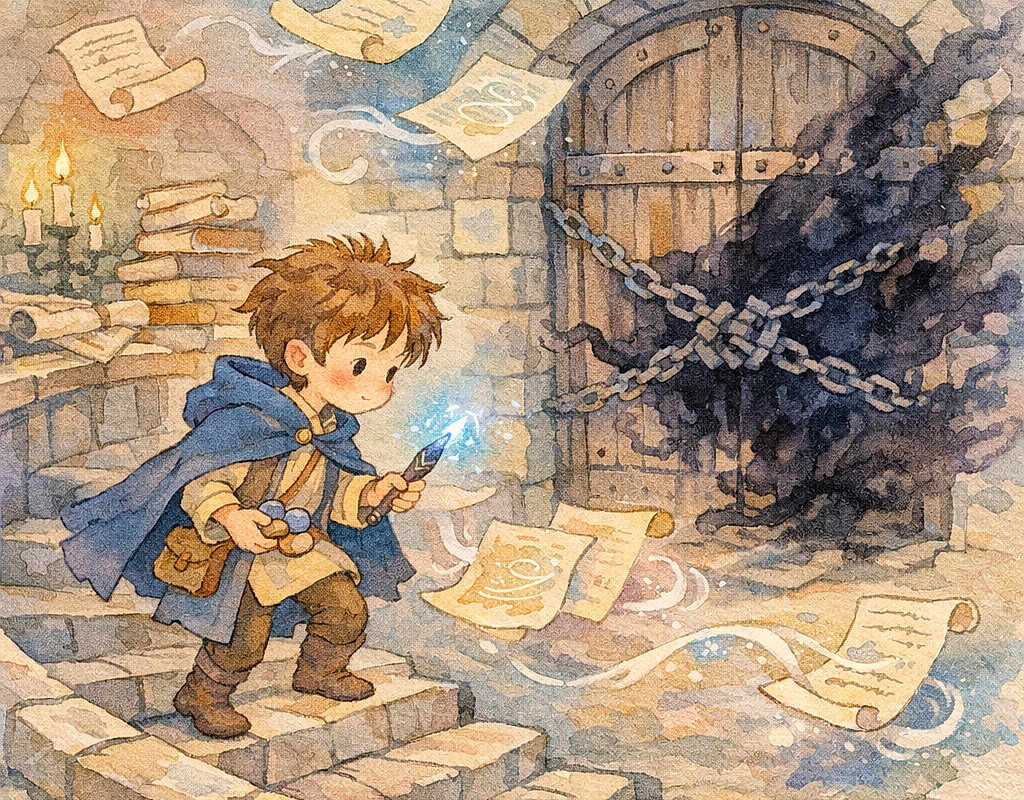
Noah had always been the kind of boy who listened to quiet things.
Not the loud quiet, like when a teacher says, “Silence!” and everyone freezes for exactly three seconds. Noah listened to the soft quiet: the hush under a door at night, the pause between two turning pages, the almost-sound a candle makes when it decides to flicker.
That was why the Rune Study Room suited him.
It wasn’t a classroom in the usual sense. It was an old, round room tucked inside the academy’s west tower, where the stone walls had been rubbed smooth by centuries of curious hands. Shelves curved along the walls like ribs around a heart, packed with slate tablets, ink-stained scrolls, and jars of chalk dust in colors that didn’t exist outdoors. The air smelled like paper, candlewax, and the faint metallic tang of old magic.
At the center stood a single table of pale wood, carved with grooves that formed a spiral. If you traced the spiral with a fingertip, you could feel tiny notches—runes, worn but still stubborn.
Noah wasn’t a natural show-off. He didn’t love being watched. When he practiced spells, he liked to do it early in the morning or late in the afternoon, when the tower’s shadows stretched long and the hallways belonged to echoes.
Professor Lark, however, was always there.
He wasn’t young. He wasn’t ancient either. He was the sort of man who looked like he had been thinking for so long that his hair had decided to turn the color of ash just to match the mood. His robes were practical, not dramatic—patched at the elbows, with pockets that bulged with oddments: a folding lens, a silver compass, a chalk holder, and a small jar labeled PLEASE DO NOT OPEN.
He also had the unsettling habit of noticing everything.
“Your left shoulder is tense,” Professor Lark said, without looking up from his book.
Noah tried to relax. “I’m not tense.”
“You are,” the Professor replied. “But you’re also determined, and that is usually a better ingredient than confidence. Most people confuse the two. Confidence is a fireworks display. Determination is a lantern.”
Noah glanced at the spiral table. “I feel like my lantern is… dim.”
“Then we trim the wick,” Professor Lark said, and finally lifted his eyes. They were sharp, gray, and kind in a way that made you suspect he could scold you while still rooting for you. “Today’s lesson: decoding a message written in layered runes.”
Noah’s stomach did a small flip. Decoding was harder than casting. Casting was like throwing a ball; decoding was like figuring out who hid the ball, where, and why.
Professor Lark slid a slate tablet across the table. It looked plain—dark stone with faint scratches. But when Noah touched it, the scratches brightened, the way frost brightens when moonlight hits it.
Symbols rose like tiny ridges under his fingertips: circles inside triangles, crooked lines that seemed to lean away from him, and one shape that made his eyes want to blink—an angular loop that didn’t quite match itself.
“Take your time,” Professor Lark said. “The room will not bite. Unless you open the wrong jar.”
Noah gave him a suspicious look.
The Professor tapped the jar in his pocket—PLEASE DO NOT OPEN—and smiled like he’d just remembered an excellent joke. “The runes are layered. The first layer says what it wants you to think. The second layer says what it doesn’t want you to know. The third layer… well. The third layer is usually a prank by the person who wrote it.”
Noah breathed in. He set his hands on the slate and let his mind settle.
The Rune Study Room did something to time. Outside, a bell might ring, or a student might shout, or wind might slam a window. Inside, all of that felt distant. The room asked for attention, and Noah, who was good at listening, offered it.
He traced the first set of symbols. He whispered the sounds Professor Lark had taught him: soft consonants that felt like brushing dust off a shelf. The scratches on the slate lit in response.
A message formed, not in ink but in a pale, floating glow.
RETURN WHAT WAS BORROWED.
Noah frowned. “That’s the first layer?”
“Yes,” Professor Lark said. “Obvious, vague, morally tidy. Continue.”
Noah found the second layer by shifting his focus—not at the symbols themselves but at the spaces between them. It was like looking at a picture until the hidden image appeared.
He spoke again, slower.
The glow wavered, then sharpened.
THE KEY IS GONE.
Noah’s throat tightened. “Key?”
Professor Lark leaned forward. His expression lost its humor. “A key can mean many things. A door key. A code key. A key-note. A key-stone. In a tower full of runes, it often means… a rune-key.”
Noah stared down at the slate. “So someone took a rune-key.”
“Or misplaced it,” Professor Lark corrected. “Or it wandered off, as keys sometimes do when no one is watching.”
Noah snorted. “Keys don’t wander.”
Professor Lark’s gaze slid to the spiral carved in the table. “In a room where symbols can move if you insult them, I wouldn’t make firm promises about objects.”
Noah’s attention dropped to the third layer. The strange angular loop—the one that made his eyes want to blink—seemed to pulse.
He swallowed. “And the third layer is the prank.”
“Usually,” Professor Lark agreed. “But sometimes it’s the truth, because truth hides better when you expect it to be silly.”
Noah traced the angular loop. It felt wrong, like trying to write with your non-dominant hand.
He spoke the last sound—a short syllable that clicked against his teeth.
The slate flashed bright enough to make him squint.
A new message spiraled upward in the air above the tablet, forming words that were almost rude in their cheerfulness.
IF YOU WANT IT BACK, ASK THE SPELLCASTER.
Silence settled.
Noah’s pulse thudded in his ears. “The Spellcaster?”
Professor Lark didn’t speak for a moment. He closed his book carefully, like he didn’t want the pages to overhear.
“There are many spellcasters,” he said at last.
Noah’s voice came out smaller than he wanted. “But… you mean the one people whisper about. The one who—”
“—collects other people’s work, yes,” Professor Lark finished. “The one who turns borrowed knowledge into locked boxes. The one who believes that if you control the keys, you control the doors.”
Noah’s hands curled on the edge of the table. He had heard stories. Everyone had. A figure in a cloak stitched with symbols, a voice like a match being struck, a laugh that sounded like pages tearing.
“And you want me to ask them?” Noah said.
“I want you to retrieve what was taken,” Professor Lark replied. “But I do not ‘want’ you to do it alone.”
Noah looked up. “You’ll come with me?”
Professor Lark’s mouth twitched. “Do you know how undignified it is for a professor to march into trouble? Rumors would be unbearable. No, Noah. You will go. But you will not go without preparation.”
He reached into his pocket and drew out a thin strip of wood the size of a pencil, wrapped in cloth.
“What is that?” Noah asked.
“A rune stylus,” Professor Lark said. “Not a wand. Wands are for people who like dramatic pointing. A stylus is for someone who understands that magic is often written, not shouted.”
Noah accepted it. The cloth felt warm, as if it had been sitting near a fire.
Professor Lark continued, “It will let you draw temporary runes on almost any surface. They won’t last long, but they’ll do what you ask—if what you ask is precise.”
Noah unwrapped it. The stylus was pale, carved with tiny grooves. When he held it, he felt a small hum in his palm, like a held breath.
“And where do I find the Spellcaster?” Noah asked.
Professor Lark’s eyes flicked to the Rune Study Room’s far wall. Noah had never paid much attention to that wall because it held nothing but a tapestry of swirling shapes. The tapestry was pretty, but not useful, like a decorative cookie tin.
Professor Lark stood and walked over. He pressed two fingers to a particular swirl.
The tapestry shivered.
Noah’s stomach dropped in the way it did when a stair step was missing.
The threads pulled aside, revealing—not a wall—but a narrow archway cut into darkness. Cold air breathed out, smelling of wet stone and ink.
Noah stared. “That was… here the whole time?”
Professor Lark nodded. “Most doors are.”
Noah’s fingers tightened on the rune stylus. “You could have told me.”
Professor Lark gave him a look. “If I tell you where every hidden door is, you will never learn to notice when a wall is lying.”
Noah stepped closer to the archway. The darkness beyond wasn’t empty. It had a texture, like a shadow thick enough to lean on.
“Where does it lead?” Noah asked.
Professor Lark’s tone softened. “To the Under-Scriptorium. A place where unfinished spells go to sulk. Where drafts of enchantments gather dust. And where someone who calls themselves the Spellcaster has been seen, lately, searching for rune-keys.”
Noah swallowed. “Why would they want a rune-key?”
“Because a rune-key can unlock patterns,” Professor Lark said. “And patterns are power.”
Noah looked down at the slate tablet. The messages had faded, as if the stone had already said too much.
“So if the key is gone,” Noah said, thinking out loud, “then something in the Rune Study Room can’t be locked properly. Or opened properly.”
Professor Lark nodded. “A missing key is a missing boundary. That is why we do not ignore it.”
Noah took a breath that felt like he was stepping onto ice. “Okay. I’ll go.”
Professor Lark’s eyes narrowed approvingly. “Good. Two rules. First: ask questions. Second: don’t accept the first answer you are given, even if it comes in an impressive voice.”
Noah hesitated. “Is that… advice about the Spellcaster?”
“It is advice about everyone,” Professor Lark said.
He reached into another pocket and handed Noah a small pouch that clinked.
Noah opened it and found three coins, each engraved with a simple rune.
“Translation tokens,” Professor Lark explained. “If you find writing you cannot interpret, press a token to it. It will offer you one honest hint. Only one. Choose carefully.”
Noah tucked the pouch into his pocket. The weight of it was strangely comforting.
Professor Lark stepped back from the archway. “Now. Go retrieve the rune-key. And Noah?”
Noah turned.
The Professor’s expression was serious. “Courage is not the absence of fear. It is deciding that fear does not get to hold the pen.”
Noah nodded, though his throat felt tight.
Then he stepped into the dark.
At first, he could see nothing. The Rune Study Room’s warm candlelight vanished behind him as the tapestry fell back into place with a whisper.
Noah stood still, letting his eyes adjust. The air was cooler here, damp against his skin. Under his feet, stone steps spiraled downward. The walls were close enough that he could touch both sides if he stretched his arms.
He went slowly, counting his steps, because counting was a way to stay steady.
After thirty steps, faint light appeared ahead—not candlelight, but something like phosphorescent ink. The stairwell opened into a low corridor lined with shelves carved into the rock. Scrolls rested there, but they looked wrong. Their paper was gray, their bindings frayed. Some had writing that crawled like insects across the surface.
Noah shivered.
A whisper floated past his ear.
He turned sharply, stylus raised.
Nothing.
Then another whisper, this time from the shelves.
“Borrowed… borrowed… returned…”
Noah’s skin prickled. “Hello?” he said, feeling foolish.
The corridor answered with a dry rustle, like a thousand pages shifting at once.
He remembered Professor Lark’s first rule: ask questions.
“Are you… the scrolls?” Noah asked.
A scroll near his shoulder wriggled. Its tie loosened on its own.
“Not scrolls,” a voice sighed. “Drafts. Attempts. Spells that never got finished. We are the almost.”
Noah swallowed. “Do you know where the rune-key is?”
The corridor seemed to brighten slightly, as if the question fed it.
“Key,” the drafts murmured. “Sharp little thing. Makes doors proud.”
“Did someone take it?” Noah pressed.
A chuckle ran down the shelves. “Someone with hands full of wanting. Someone who wears symbols as if they were armor.”
Noah tried to keep his voice steady. “The Spellcaster.”
The drafts hummed, pleased. “Yes. Yes. Went deeper. Toward the Inkwell Gate.”
Noah’s heart pounded. “How do I get there?”
The drafts rustled like a shrug. “Follow the drip that does not fall.”
Noah frowned. “That doesn’t make sense.”
“Most true directions do not,” the drafts replied lazily.
Noah held up the rune stylus, considering. A drip that does not fall. He listened.
At first, he heard only his own breathing. Then, faintly, a slow plink—like water dripping. But the sound was too steady, too perfect, as if someone had practiced being a drip.
He followed it.
The corridor narrowed, then widened into a chamber where the ceiling arched low. In the center stood a stone fountain, dry as bone. Above it hung a single drop of ink, suspended in midair. It trembled, but never fell.
Noah approached carefully.
The ink drop reflected him, but not quite right. In the reflection, his eyes looked older. His shoulders looked heavier.
He reached out and stopped his finger an inch away.
The ink drop pulsed.
A thin line of ink stretched from it, pointing like a compass needle toward a doorway on the far side of the room.
Noah exhaled. “Okay. I get it.”
He walked through the doorway.
Beyond was a hall that looked like it had been built inside a book. The walls were layered with stone slabs etched with runes, stacked like pages. Between the slabs, thin seams glowed faintly, as if the words inside were trying to escape.
Halfway down the hall, something moved.
Noah froze.
A figure stood ahead, back turned. Cloaked, tall, their robe stitched with symbols that caught the dim light. The hood hid their face.
Noah’s mouth went dry.
The figure’s voice drifted back without them turning. “You’re loud for someone trying to be brave.”
Noah flinched. “I’m not trying to be brave.”
The Spellcaster laughed softly. “That’s what brave people say. They don’t notice themselves doing it.”
Noah forced his legs to move forward. Each step felt like walking into a test he hadn’t studied for.
“I’m here for the rune-key,” he said, keeping his voice as steady as he could.
The Spellcaster turned.
Noah expected a face like the rumors: sharp, cruel, smug.
Instead, he saw a face that looked… tired. Pale, with dark circles beneath the eyes. The Spellcaster’s gaze was bright, though—too bright, like a candle flame that had been fed something other than wax.
“You’re the professor’s boy,” the Spellcaster said.
Noah’s jaw tightened. “I’m Noah.”
“Names are small doors,” the Spellcaster murmured. “And people guard them fiercely. Noah, then.”
Noah held his ground. “Did you take the rune-key from the Rune Study Room?”
The Spellcaster tilted their head. “I borrowed it.”
Noah remembered the slate message: RETURN WHAT WAS BORROWED.
“It wasn’t yours to borrow,” Noah said.
The Spellcaster’s eyes narrowed. “Everything is borrowed. The air. The light. The words you speak. Even your courage—you borrow it from the future version of yourself who survives.”
Noah didn’t like that sentence, even though part of him felt its truth.
He tried another question. “Why do you need it?”
The Spellcaster stepped closer, and the runes on their robe shifted, rearranging into new patterns. Noah’s fingers tightened around his stylus.
“I need a door opened,” the Spellcaster said. “A door that should never have been locked in the first place.”
Noah’s mind raced. “What door?”
“The Archive of First Marks,” the Spellcaster said, voice dropping. “The place where the earliest runes were carved, before professors decided who deserved to learn them.”
Noah’s stomach twisted. “So you want to steal powerful magic.”
The Spellcaster’s mouth curved, not into a smile but something like a grim line. “Steal? No. Reclaim. Knowledge is a river. Your academy built dams.”
Noah thought of Professor Lark’s patched elbows, his careful lessons, his patient voice.
“Professor Lark doesn’t hoard knowledge,” Noah said.
The Spellcaster’s gaze sharpened. “Perhaps not. But the tower does. The system does. The rules do. And the rules are written in runes.”
Noah hesitated. There was a pull in the Spellcaster’s words—an invitation to agree, to feel important for standing beside someone who spoke like thunder.
Professor Lark’s second rule echoed: don’t accept the first answer you are given, even if it comes in an impressive voice.
Noah took a careful breath. “Even if some rules are unfair, taking the key hurts everyone who needs the Rune Study Room safe.”
The Spellcaster’s eyes flicked, almost surprised.
Noah continued, gaining steadiness. “A missing key is a missing boundary. Professor Lark said that. If the room can’t lock properly, something could slip through. Something dangerous.”
The Spellcaster’s face went still.
For a moment, Noah thought he had won.
Then the Spellcaster said quietly, “Perhaps that is exactly what I need.”
Noah’s heart lurched. “You want something dangerous to slip through?”
The Spellcaster lifted a hand. In their palm, a small object glinted: a metal key, etched with runes so fine they looked like hairline cracks.
“This key opens more than doors,” the Spellcaster said. “It opens assumptions.”
Noah swallowed. “Give it back.”
The Spellcaster’s voice softened, almost gentle. “Noah. Do you know why you were sent, and not the professor?”
Noah didn’t answer.
“Because the professor believes you can choose,” the Spellcaster continued. “Professors love choice when it means students choose the professor’s path. But this time, you can choose mine.”
Noah’s cheeks heated. “I didn’t come to join you.”
The Spellcaster’s fingers closed around the key. “Then take it from me.”
Noah’s body went cold.
He wasn’t a duelist. He wasn’t the sort of boy who threw himself into fights. He was a boy who listened to quiet things.
But he had a rune stylus.
And he had determination.
Noah raised the stylus and drew a quick rune in the air. Professor Lark had taught him simple shapes that could stick to surfaces briefly.
He drew one now: a binding mark.
The air shimmered. The rune snapped forward like a net.
The Spellcaster moved faster than Noah expected. They twisted, and their robe’s symbols flared. The net rune slid off as if the Spellcaster’s clothing were slick with oil.
Noah stumbled back, startled.
The Spellcaster laughed. “Temporary runes? Clever. But you’re writing on the wind.”
Noah’s mind raced. He needed a surface.
His eyes flicked to the hall’s walls—stacked rune-slabs like pages. Plenty of surface.
He sprinted sideways and slammed the stylus against the nearest slab, drawing a large rune: a mirror-mark, meant to reflect spells.
The stone glowed.
The Spellcaster lifted their hand and flicked a spell like a lash—dark ink whipping toward Noah.
It hit the mirror-mark and snapped back.
The Spellcaster jerked, surprised, and the ink-lash struck their own sleeve, staining the runes there.
For the first time, the Spellcaster looked genuinely annoyed.
Noah’s heart pounded, but a thin thread of triumph ran through him.
“I can learn,” Noah said, breathless.
The Spellcaster’s eyes narrowed. “Good. Then learn this.”
They pressed the rune-key into the wall.
The slab trembled. The seams between the stones brightened, and the hall’s runes began to rearrange themselves, sliding like puzzle pieces.
Noah felt the floor shift.
The hall was becoming a door.
A deep hum filled the air, like a giant clearing its throat.
Noah shouted, “Stop!”
The Spellcaster didn’t.
The wall split open, revealing a circular chamber beyond, lit by a strange pale glow. In the center floated a ring of symbols—ancient, heavy, and beautiful in a way that made Noah’s teeth ache.
The Archive of First Marks.
Noah stepped forward without meaning to, drawn by the runes’ gravity.
The Spellcaster’s voice came low and reverent. “Do you feel it? The source. The beginning.”
Noah did feel it. The runes in the air weren’t just symbols; they felt like ideas given shape.
But he also felt something else.
A cold draft.
Not from the doorway behind them, but from inside the chamber, as if the Archive breathed outward.
Noah listened, the way he always did.
Under the hum of ancient magic, he heard a scrape-scratch sound—like nails on stone.
He looked around.
In the chamber’s shadows, shapes moved. Not people. Not drafts of spells.
Things made of leftover magic—half-formed enchantments that had never been finished, hungry for structure.
Noah’s mouth went dry. “Those… are not supposed to be awake.”
The Spellcaster’s expression faltered.
The shadow-things drifted closer, attracted to the rune-key’s power like moths to flame.
One reached out, and its fingers were made of broken lines.
It touched the floating ring of ancient runes.
The ring shuddered.
The chamber’s glow flickered.
Noah’s fear hit him like a wave.
If the Archive destabilized, the runes could spill, twist, and rewrite parts of the tower—maybe even minds.
The Spellcaster turned sharply, suddenly alert. “Stay back.”
Noah almost laughed. “Now you’re cautious?”
The Spellcaster’s jaw clenched. “I didn’t expect…”
“You didn’t expect consequences,” Noah snapped, surprising himself.
A shadow-thing lunged.
The Spellcaster flung a spell—bright, sharp, like a blade of light. It cut through the creature, but the creature didn’t die. It split into two smaller shapes, both still moving.
Noah’s hands shook.
He remembered Professor Lark’s lantern metaphor. Trim the wick.
He forced himself to focus.
What did these creatures want? Structure. A pattern. A place to fit.
Noah had a stylus that could draw temporary runes.
Maybe he didn’t need to fight them.
Maybe he could give them something else to cling to.
He dropped to one knee and pressed the stylus to the stone floor, drawing quickly: a containment circle, made of linked runes.
The circle glowed faintly.
The nearest shadow-thing veered toward it, as if pulled. It slid into the circle and stuck, trembling.
Noah’s chest tightened with relief.
It worked.
But there were more.
Two more drifted, then four, then a whole swarm crawling from the shadows like ink spilled across a page.
Noah’s circle held only one.
He needed something larger.
His eyes snapped to the floating ring of ancient runes.
No. Too dangerous.
Then he saw the rune-key in the Spellcaster’s hand.
A key meant to lock boundaries.
Noah’s voice came out hoarse. “The key can lock the Archive back up. You have to close the door.”
The Spellcaster hesitated, eyes flicking between the creatures and the runes. For a heartbeat, Noah saw the Spellcaster’s desire like a physical thing—hands reaching.
Then a shadow-thing brushed the Spellcaster’s shoulder.
The runes on the robe flickered and scrambled, as if the creature tried to rewrite them.
The Spellcaster recoiled, fear finally cracking through their arrogance.
“All right,” the Spellcaster hissed. “All right!”
They shoved the key into the wall again, but the door did not move.
The key’s runes glowed, then dimmed.
Noah’s eyes widened. “It’s not working.”
The Spellcaster stared at the key as if it had betrayed them. “It should.”
Noah’s mind raced.
A rune-key didn’t just open or close. It responded to the pattern it was meant to match.
If the door had been rearranged, the lock pattern might have shifted.
Noah remembered the lesson: layered runes, hidden meanings.
He reached into his pocket and felt the translation tokens.
He pulled one out and pressed it to the wall near the keyhole.
The coin warmed, and a single word formed in his mind, clear as spoken aloud:
COMPLETE.
Noah blinked. “Complete?”
The Spellcaster snarled, batting at a shadow-thing. “What are you doing?”
Noah’s thoughts sharpened. The door was made of rune-slabs like pages. The lock pattern needed to be completed. Maybe the Spellcaster’s forced opening had disrupted it.
Noah pointed at the seams between stones. “The runes are incomplete now. We need to rewrite the lock pattern so the key recognizes it.”
The Spellcaster’s eyes flashed. “You can’t rewrite ancient locks.”
Noah swallowed his fear. “I can try.”
He ran to the doorway, where the hall’s runes had slid apart. The symbols were misaligned, like a sentence scrambled.
Noah lifted his stylus.
His hands trembled, but he steadied them by listening. The room hummed. The creatures scratched. The runes whispered.
He looked for repetition, for rhythm—the way words repeated in a poem.
There.
Three runes along the seam formed a pattern: curve, dot, line.
The fourth should be… the angular loop from the slate message.
Noah’s stomach clenched. That loop had felt wrong.
But wrong didn’t mean bad. It meant precise.
He drew it carefully on the stone seam.
The line caught light.
The wall shuddered as if relieved.
Noah moved to the next seam, repeating the pattern, completing the sentence the door was trying to say.
Behind him, the Spellcaster fought, spells flashing like sparks.
“Faster!” the Spellcaster barked.
Noah’s jaw tightened. “I’m not a machine.”
“Then be a miracle,” the Spellcaster snapped.
Noah almost lost his focus. Anger flared.
Then he remembered: fear doesn’t get to hold the pen.
Neither did the Spellcaster.
Noah drew the final angular loop.
The seams glowed bright.
The doorway’s edges straightened. The hall’s slabs clicked into alignment with a sound like a book closing.
Noah shouted, “Now! Use the key!”
The Spellcaster slammed the rune-key into the keyhole.
This time, the key’s runes blazed.
The door began to swing shut.
A swarm of shadow-things surged forward, desperate, trying to escape the closing boundary.
Noah acted without thinking.
He drew a single large rune in the air—one Professor Lark had called the Anchor Mark. It was used to pin temporary magic to something stable.
Noah aimed it at the doorway.
The rune slammed into the closing seam and held.
The door sped up, snapping shut like a jaw.
The last shadow-thing slammed against it and dissolved into harmless dust that drifted to the floor like gray snow.
Silence.
Noah stood frozen, panting.
The Spellcaster leaned against the wall, breathing hard. Their robe’s runes were scrambled in places, some still flickering as if trying to remember what they were.
For a long moment, neither of them spoke.
Then Noah said quietly, “Give me the key.”
The Spellcaster looked at the key in their hand. Their fingers tightened.
Noah lifted his stylus, not threatening, just steady. “You saw what happens when boundaries break. The Rune Study Room needs it.”
The Spellcaster’s eyes narrowed, and Noah thought they might attack.
Instead, the Spellcaster let out a bitter laugh. “You’re stubborn.”
“I’m determined,” Noah corrected.
The Spellcaster studied him, then—slowly—held out the rune-key.
Noah took it.
The key was colder than he expected, heavy with carved meaning.
As soon as Noah’s fingers closed around it, the runes on the key shifted slightly, like they had been waiting for the right hand.
The Spellcaster’s gaze flicked to that movement.
“What did it do?” the Spellcaster asked, voice sharp.
Noah looked down. A faint new line had appeared on the key, a rune he hadn’t seen before—simple, like a small lantern.
He felt a warm hum in his palm.
“It… changed,” Noah said.
The Spellcaster’s expression turned hungry again. “It accepted you.”
Noah backed away half a step. “Or it’s just happy to be returned.”
The Spellcaster’s laugh was softer this time. “You think objects have feelings.”
Noah remembered the drafts calling themselves the almost. He remembered the ink drop that didn’t fall.
“In this place,” Noah said, “I’m not sure feelings are limited to people.”
The Spellcaster’s gaze drifted past Noah, toward the sealed doorway.
For the first time, the Spellcaster looked small.
“I wanted the first runes,” they said, voice low. “I wanted to prove the tower wrong about me.”
Noah frowned. “Wrong about you?”
The Spellcaster’s eyes flashed. “They said I was reckless. They said my questions were dangerous. They said I made other students nervous. So they took away my access. They put me outside the lessons, outside the rooms, outside the doors.”
Noah felt a pinch of sympathy he hadn’t expected.
“But stealing the key—” Noah began.
“I know,” the Spellcaster interrupted, voice tight. “I know what I did. Don’t give me a lecture. I’ve swallowed enough of those to choke.”
Noah hesitated, then said, “Professor Lark sent me because he thought I could choose.”
The Spellcaster’s mouth twisted. “And you chose him.”
Noah shook his head. “I chose the tower not falling apart. I chose not letting hungry spell-drafts leak into hallways. I chose… everyone.”
The Spellcaster stared.
Noah added, quietly, “That doesn’t mean you’re wrong to ask hard questions.”
The Spellcaster blinked, as if Noah had thrown water on a flame.
For a moment, Noah saw a different version of them: not a villain in rumors, but someone who had gotten tired of knocking.
Then the Spellcaster straightened. Their voice regained a sharper edge, like armor sliding back into place. “Go, then. Return the key. Tell your professor his door still works.”
Noah tightened his grip on the rune-key. “What will you do?”
The Spellcaster’s gaze slid away. “Disappear, as usual.”
Noah’s chest tightened again. “You could come back. Talk to him. Not like—”
“Not like a storm?” the Spellcaster finished. “Maybe. But not today.”
Noah didn’t know what to say.
So he did the only thing he could: he nodded once, turned, and walked back through the rune-slab hall.
The corridor of drafts was quieter now, as if it had been lulled to sleep by the closed door.
As Noah climbed the spiral steps, the air warmed. The hum of the tower returned.
When he reached the tapestry, it parted at his touch this time, as if recognizing him.
He stepped into the Rune Study Room.
Candlelight welcomed him like a familiar face.
Professor Lark stood at the central table, hands folded behind his back. He looked as if he had not moved, but his eyes were too alert.
Noah held up the rune-key.
Professor Lark exhaled—a small, controlled release of tension. “You found it.”
Noah nodded. “And I locked something else back up.”
Professor Lark’s gaze sharpened. “Tell me.”
Noah did. He explained the Under-Scriptorium, the suspended ink drop, the spell-drafts, the rune-slab hall, the Archive of First Marks, the shadow-things, the misaligned lock pattern, and the angular loop rune that completed it.
Professor Lark listened without interrupting. When Noah finished, the Professor’s expression was unreadable.
“You met the Spellcaster,” he said.
Noah nodded.
“And you returned with the key,” Professor Lark continued. “And with your eyebrows intact. Impressive.”
Noah managed a weak smile. “Barely.”
Professor Lark took the key and turned it in his fingers, studying the new lantern-like rune that had appeared.
“This is… interesting,” he murmured.
Noah leaned forward. “What does it mean?”
Professor Lark’s eyes flicked up. “It means the rune-key has adapted. It now carries a personal imprint. Yours.”
Noah’s stomach flipped again. “Is that bad?”
“Not at all,” Professor Lark said. “It means you’ve been recognized as someone who can complete patterns under pressure. That is not a common skill.”
Noah’s cheeks warmed. “So… what happens now?”
Professor Lark walked to a small cabinet Noah had never seen opened. He unlocked it with the rune-key.
Inside lay a narrow box of polished wood.
Professor Lark lifted it out and set it on the table. “Fan service,” he said, completely straight-faced.
Noah blinked. “What?”
Professor Lark cleared his throat, as if he had said something inappropriate. “Ahem. I mean: a practical reward. Courage and good work deserve something tangible. Open it.”
Noah’s hands hovered, then he opened the box.
Inside rested a set of three thin metal plates, each engraved with complex runes that shimmered faintly.
“What are these?” Noah whispered.
“Rune Shields,” Professor Lark said. “Portable. When you press one to a surface, it unfolds into a barrier for a few seconds. Enough to block a spell, or—more importantly—buy time to think.”
Noah picked one up. It was cool and perfectly balanced.
Professor Lark added, “And because the rune-key has marked you, the shields will respond better in your hands than in anyone else’s.”
Noah’s eyes widened. A real tool. Not just praise.
Professor Lark’s voice softened. “You did well, Noah. You listened. You questioned. You did not let someone else’s impressive voice write your choices.”
Noah looked down at the rune shields, then back up. “The Spellcaster… they weren’t only a monster.”
Professor Lark’s gaze turned thoughtful. “No one is only a monster. Some people become dangerous because they are hurt and refuse to heal in a way that doesn’t bruise others.”
Noah hesitated. “Will you… do something about them?”
Professor Lark’s eyes narrowed slightly—not in anger, but in careful thought. “Yes. But not with a chase. Not with a duel. I will start with a door and a conversation.”
Noah nodded slowly.
Professor Lark placed the rune-key back in the cabinet, then paused. “One more thing.”
He reached into his pocket and pulled out the jar labeled PLEASE DO NOT OPEN.
Noah stiffened. “Professor.”
Professor Lark’s mouth twitched. “I am not opening it. I am giving it to you.”
Noah recoiled. “No.”
Professor Lark held it out. “It’s empty.”
Noah blinked. “It is?”
Professor Lark nodded solemnly. “I kept it labeled like that because students behave better around forbidden jars. It’s a useful trick.”
Noah stared, then let out a laugh that surprised him. It started small and then grew, shaking loose the tightness in his chest.
Professor Lark watched him with quiet satisfaction.
Noah wiped his eyes. “That’s… unfair.”
Professor Lark’s voice turned light again. “Life is full of unfairness. The question is whether you use it to hoard power or to encourage caution. Now, take your empty jar. Put something in it that matters to you. A token. A memory. A promise. And label it honestly.”
Noah accepted the jar. It was lighter than he expected, and that made it feel full of possibility.
He looked around the Rune Study Room—the spiral table, the shelves, the calm candlelight.
He had gone into the dark and returned with more than a key.
He had returned with a skill: the ability to see patterns when fear tried to scramble them.
He had returned with rune shields—real, shining plates that felt like proof in his hands.
And he had returned with a new awareness: even an antagonist might be someone who had once been a student, knocking on a door.
Professor Lark settled back into his chair and opened his book again. “All right, Noah. Next lesson.”
Noah swallowed. “After today?”
Professor Lark’s eyes twinkled. “Especially after today. The tower does not get safer because you survived once. It gets safer because you learn what to do the next time.”
Noah set his jar on the table, placed the rune shields neatly beside it, and picked up his stylus.
His lantern wasn’t dim anymore.
It wasn’t a fireworks display, either.
It was steady, bright enough to read by.
And in the quiet between turning pages, Noah listened—ready to write his own choices, one careful rune at a time.