
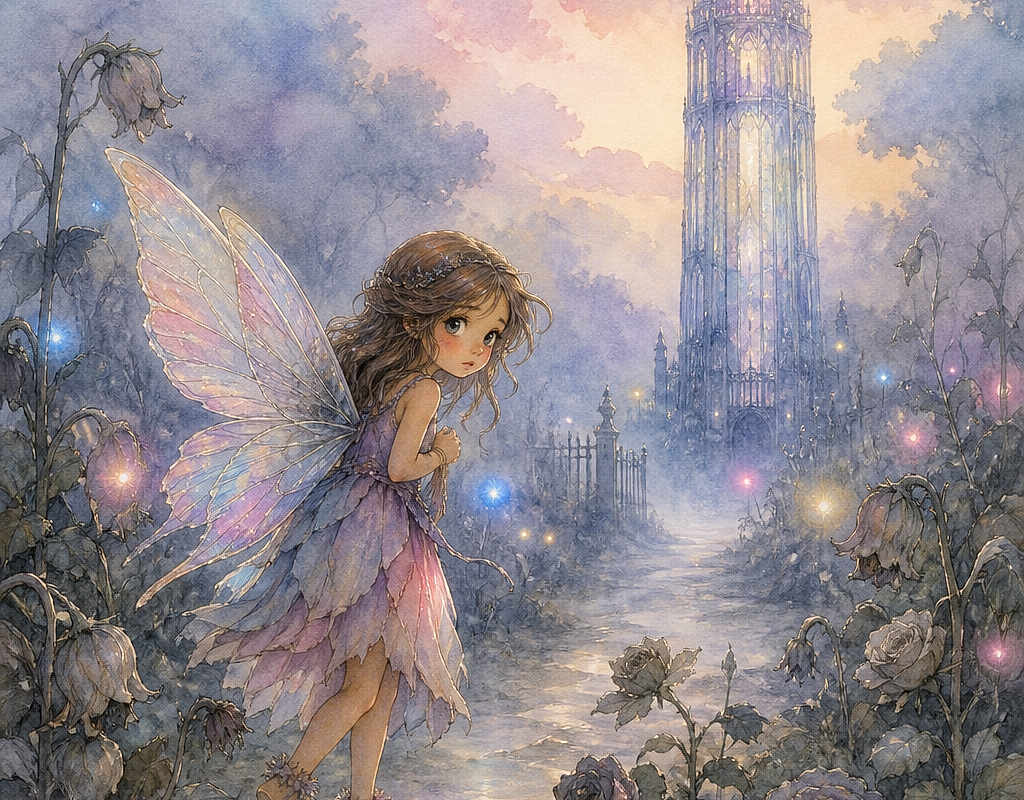
At the edge of the Spirit Garden, where the roots of old trees shone faintly beneath the soil, lived a fairy named Avah. She was not the sort of fairy who made grand entrances. Her wings were silver-green, like dew on a fern, and when strangers spoke to her, she often folded them close and looked at the ground before answering. Yet Avah noticed things everyone else missed: the worried tilt of a tulip’s head, the tired hum in a bee’s wings, the silence that meant a stream was hiding a secret.
Each dawn, she flew among the garden’s thousand paths with a tiny brass watering can and a satchel of seeds. The Spirit Garden was no ordinary place. Every flower held a memory, every pond reflected a possible future, and every stone kept one small promise made by someone passing by. In the center stood the Heartbloom, a vast white flower whose petals opened only when the garden was peaceful. Its light kept the borders bright and safe.
On the morning that changed everything, Avah found the Heartbloom closed.
Not merely closed, she thought. Afraid.
Its white petals had turned the gray of moonlit ash. Around it, the garden’s colors were fading. Red poppies became dull clay. Bluebells looked like crumpled paper. Even the goldfish in the Mirror Pond swam through water as colorless as rain.
Avah hovered above the flower, her fingers trembling. “Heartbloom? Can you hear me?”
A thin sound answered from deep inside the petals. It was almost a whisper, almost a sigh.
“The colors have been taken.”
Avah turned sharply. On the mossy wall behind the flower, someone had painted a spiral in black dust. At its center was the unmistakable mark of Wizard Veyl: a crooked crescent crossed by three claw-like lines.
Everyone in the Spirit Garden knew the stories. Wizard Veyl lived beyond the north hedge in the Tower of Weathered Glass. Long ago, he had been a keeper of enchanted pigments, able to paint dawns across the sky. But he had grown bitter when people praised the bright gardens and forgot the quiet hands that tended them. Now he collected beautiful things and locked them away, declaring that the world did not deserve to enjoy what it failed to appreciate.
Avah had never met him. She hoped she never would.
“You have met him now, in a manner of speaking,” said a calm voice.
From behind the Heartbloom rose Oracle, the garden’s oldest guardian. Oracle was a large, pale moth with velvet wings patterned like night maps. A tiny bronze lantern hung beneath his chin, though no one had ever seen him light it with a match. He was wise, patient, and occasionally so mysterious that even the mushrooms complained about it.
“Oracle,” Avah said, relieved and frightened at once. “Veyl took the colors. Can we stop him?”
“We can try,” Oracle replied. “But the Wizard did not steal paint from petals. He stole the three Color Springs beneath the garden: Crimson Courage, Azure Wonder, and Golden Kindness. Their waters feed every living shade here. He has sealed them inside his tower.”
“Then we go to the tower.”
Oracle’s lantern glimmered once. “The path to it has changed. Veyl has made a bargain with the Gloam Mist. It will confuse anyone who walks through it.”
Avah swallowed. She disliked deep fog, sudden noises, and plans that depended on her being brave. Unfortunately, this plan contained all three.
“The Heartbloom is fading,” she said. “If its light goes out, the garden’s spirit creatures will lose their homes.”
Oracle studied her with gentle black eyes. “Courage is not the absence of fear, Avah. It is deciding that something else matters more.”
Avah did not feel heroic. She felt like a small fairy with a brass watering can. But she looked at the gray petals, at the faded garden, and at a ladybug crawling in confused circles across a colorless leaf.
“Show me the way,” she said.
Before leaving, Avah gathered what she could. She packed moon-mint for clear thinking, three seed-bombs that would sprout thorny vines when thrown, a spool of spider-silk thread, and her grandmother’s magnifying pebble. It could reveal hidden writing, though it had once revealed that Avah had accidentally written “turnip soup” on a birthday card meant for a prince.
Oracle gave her a silver bell no bigger than an acorn. “Ring this only when you know what you are asking for,” he told her.
“What does it do?”
“It answers true requests.”
“That is not very specific.”
“Specificity is often the first victim of magic,” Oracle said, and fluttered toward the northern hedge.
The garden paths had always seemed friendly to Avah. That day, as their colors drained away, they appeared unfamiliar. The Laughing Lilac Maze had stopped laughing. The Stream of Little Songs gurgled only one sad note. Avah and Oracle passed statues of foxes, swans, and children that were actually spirits resting in stone. Their blank gray faces seemed to watch her go.
At the north hedge, they found a narrow opening filled with mist. It poured between the thorn branches like smoke from an invisible fire. Beyond it, nothing could be seen.
Oracle’s antennae twitched. “The Gloam Mist feeds on uncertainty. It will make you see roads that are not there and hear voices that wish to turn you around.”
Avah tied one end of the spider-silk around a thorn and held the other tightly. “Then we keep hold of this.”
“A sensible beginning,” Oracle said.
They entered.
The mist was cold and smelled of old ink. At first there was only white-gray fog, their own breaths, and the soft clink of Oracle’s lantern. Then Avah heard a voice behind her.
“Avah,” it called. It sounded exactly like her grandmother. “Come back, little leaf. This is too dangerous.”
Avah’s heart squeezed. Her grandmother had been gone for many seasons. For one foolish, aching moment, Avah wanted to fly toward that voice.
Then she noticed something wrong. Her grandmother had always called her “little comet,” never “little leaf.”
“That isn’t her,” Avah whispered.
The mist hissed.
A second voice came, this one sharp and familiar. “You will make a mistake. You always do.” It was Avah’s own voice.
She tightened her grip on the silk. “Probably,” she said aloud. “But I can fix mistakes. I’m still going.”
Oracle’s lantern gave a pleased flicker. The fog thinned around their feet.
Soon they reached a fork where three paths appeared. One was paved with bright blue stones, one with soft moss, and one with glittering sugar crystals. A wooden sign said, TOWER OF WEATHERED GLASS, with three arrows pointing in three different directions.
“That seems inconvenient,” Avah muttered.
Oracle leaned close to the sign. “All three arrows are freshly painted. Veyl wants us to choose wrongly.”
Avah took out her magnifying pebble. Under its round lens, the blue-stone arrow revealed a trail of tiny boot prints leading in circles. The moss arrow hid a line of spiderwebs stretched low, ready to trap wings. But the sugar-crystal arrow had no secret writing at all.
“Maybe the honest path is the one that does not try to impress us,” Avah said.
They chose the plain-looking trail beneath the crystals. It was not sugary at all; the glitter was frost on rough black stones. At its end stood a ravine spanned by a bridge made from enormous piano keys. Each key bore a different symbol: a flame, an eye, a leaf, a teardrop, a star, a hand, and a feather.
Across the ravine, a stone raven lifted its head. “Only a true sequence may cross,” it croaked. “One false step, and the bridge will sing you into the wind.”
“Sing us into the wind?” Avah asked.
“You will not enjoy the harmony,” said the raven.
Oracle inspected the keys but said nothing. Avah knew why. He was testing whether she would trust herself.
She looked at the symbols. The Color Springs: Crimson Courage, Azure Wonder, Golden Kindness. Flame for courage, eye for wonder, hand for kindness. But the bridge had seven keys, not three, and the raven had said sequence.
Then Avah remembered the Heartbloom’s faint message: The colors have been taken. Not destroyed. She remembered how a garden grew: a seed was planted, watered, warmed, and cared for before it flowered.
“A feather,” she said. “First, you notice what needs help. Then the eye: you look closely. Then the hand: you help. Then the teardrop, because caring can hurt. Then the leaf, because you keep growing. Then the flame, courage. And last, the star, because you hope.”
The raven stared. “That is not the old sequence.”
Avah’s face warmed. “Oh.”
“But it is a living one,” the raven said. “Proceed.”
The keys sounded as she stepped: a soft flute, a drum, a chime. Oracle followed, his wings spread wide. Halfway across, a violent gust tore through the ravine. Avah slipped. Her feet left the key, and the world dropped away beneath her.
Oracle caught the spider-silk line in his claws, but he was too light to pull her up.
“Let go of your bag!” he called.
“My seeds!” Avah gasped.
“Your life first!”
Avah nearly refused. The bag held all her useful things. Yet she remembered the garden, empty of color. She unhooked it. The satchel fell into the chasm, scattering moon-mint and seed-bombs like tiny stars.
Her weight lifted. Oracle hauled the silk, and Avah landed hard on the star key. The bridge played one enormous triumphant note.
On the far side, she sat shaking while Oracle rested beside her.
“I am sorry,” he said quietly. “I should have helped sooner.”
“You did help.”
“I allowed the riddle to be yours.”
“That was wise,” Avah said. “But maybe next time, be wise faster.”
For the first time that day, Oracle made a sound like a laugh. “An excellent instruction.”
The Tower of Weathered Glass rose beyond the ravine. It was taller than Avah expected, built from panels of cloudy green glass fused into a crooked spiral. Inside its walls, storms flashed without sound. At the top, three lights pulsed: one red, one blue, one gold.
They had found the springs.
The tower door was open.
That frightened Avah more than a locked door would have.
Inside, hundreds of paintings covered the walls. There were paintings of emerald jungles, ruby sunsets, violet mountains, and laughing children with bright scarves. Every color in the world seemed trapped inside the frames. Yet each picture was unfinished. A bird had no sky. A city had no lamps. A feast had no faces around its table.
At the center of the hall stood Wizard Veyl.
He was thin and tall, wrapped in a coat patched from faded canvases. His beard was braided with paintbrushes, and his eyes were the silver-gray of rainclouds. He held a long brush whose bristles smoked with darkness.
“Ah,” he said, without turning. “The Spirit Garden sends a moth and a child.”
“I’m not a child,” Avah said, then wished she had said something more impressive.
Veyl glanced over his shoulder. “No? Then why do you carry a watering can?”
Avah looked down. She had forgotten she still held it. “Because gardens need water.”
“Gardens need admiration,” Veyl snapped. His brush struck the air. A black stroke became a flock of paper crows that circled the ceiling. “For centuries, I gave color to celebrations, banners, royal halls, and garden festivals. People clapped for the kings who commissioned me. They praised the flowers, the music, the sunrise. No one asked who mixed the first gold into dawn.”
Oracle flew forward. “Being unseen wounded you. That is true. But stealing light from innocent lives cannot heal the wound.”
Veyl’s face tightened. “You speak as if you understand.”
“I understand loneliness,” Oracle replied.
For a moment, the paper crows stopped flapping.
Avah saw something behind Veyl: a small table holding a dusty portrait. In it, a younger Veyl stood beside a garden, smiling shyly. Next to him was a girl wearing a crown of marigolds. The painting was faded almost to nothing.
Veyl noticed Avah looking. With a furious gesture, he covered the portrait in black paint.
“Enough,” he said. “You may leave with one color. Choose carefully. Red, blue, or gold. The garden will survive a little longer, and I will keep the rest.”
Avah’s thoughts spun. One color was a cruel bargain. If she chose courage, would wonder and kindness vanish? If she chose kindness, could the garden live without bravery? This was what Veyl wanted: for her to believe that one precious thing must be abandoned to save another.
“No,” Avah said.
Veyl lifted an eyebrow. “No?”
“The Spirit Garden needs all its colors. And so do people.”
The wizard’s brush cracked against the floor. Black paint rushed outward in a wave. It became a ring of thorny vines around Avah and Oracle. The thorns grew thicker by the second, and their tips leaked ink.
Oracle beat his wings, but the blackness weighed them down. Avah reached for a seed-bomb, then remembered she had dropped her satchel. Her hands felt empty. Her throat felt tight.
Veyl stepped closer. “You see? Caring does not make you strong.”
Avah looked at the tower’s many unfinished paintings. “No,” she said. “But it tells me what strength is for.”
She raised her brass watering can.
Veyl laughed. “That is your weapon?”
“It is my tool.”
Avah whispered a gardener’s spell, one she used every spring on stubborn seeds. “Wake gently. Root deeply. Reach toward light.”
Only three drops of water remained in the can. She sprinkled them on the floor.
For a heartbeat, nothing happened.
Then, far below the tower, something answered.
The seed-bombs that had fallen into the ravine had struck cracks in the stone. Nourished by the underground waters, they had sprouted. Thorny vines climbed the ravine wall, curled around the tower’s foundations, and burst through the glass floor in a green spiral. They were not black, angry thorns. They were wild rose vines, bright with leaves and fierce with life.
The vines shattered the inky cage around Avah. One wrapped carefully around Oracle and lifted him free.
Veyl staggered backward. “My tower!”
The walls trembled. The red, blue, and gold lights above them flashed wildly.
Avah flew toward the spiral staircase, but Veyl swept his brush. A painted dragon tore itself from a wall and lunged at her. Its scales were wet crimson, its teeth made of splintered frames.
Avah swerved, barely escaping its jaws. She was quick among flowers, but the tower’s air was full of broken glass and storm wind. The dragon circled again.
“Avah!” Oracle called. “It is paint. It follows the strongest color!”
The strongest color. Avah thought of Veyl’s anger, dark and heavy. She thought of the red lamp overhead. Then she saw the hidden portrait beneath its smear of black paint.
“Wizard Veyl!” she shouted.
He looked at her despite himself.
“Who was the girl in the portrait?”
The dragon faltered.
Veyl’s expression became still. “My sister,” he said. “Liora.”
“What happened to her?”
“She became ill during the Gray Winter. I painted her a garden so she could remember spring.” His voice had lost its sharpness. “She said it was beautiful. Then she was gone.”
The dragon’s red scales paled. It drooped in the air, suddenly no fiercer than a kite in rain.
“You have been painting alone ever since,” Avah said.
“Do not pity me.”
“I don’t,” she answered honestly. “I think you loved her. And I think you are still trying to make a place where nothing beautiful can leave you.”
Veyl’s brush shook in his hand.
Oracle landed beside Avah. “A locked treasure is safe from loss,” he said, “but also safe from being loved.”
The tower groaned again. A crack split the ceiling near the three springs. Black mist began pouring from it, twisting around the colored lights.
Veyl looked up in alarm. “No. The Gloam Mist was meant only to guard the tower.”
“It has been feeding on your grief,” Oracle said. “Now it wants every color for itself.”
The crack widened. The mist formed a vast face with no eyes, only a mouth of swirling ash.
LEAVE THE COLORS, it whispered inside their minds. LEAVE THE MEMORIES. LEAVE EVERYTHING THAT CAN HURT.
Avah’s legs went cold. The offer was terrible because it sounded tempting. No hurt. No fear. No grief. But no joy, either. No bright petals, no beloved voices, no courage needed because nothing would matter.
Veyl raised his brush against the mist. “I commanded you!”
The Gloam Mist struck him. Darkness wrapped around his arms and dragged him toward the ceiling crack.
Avah flew after him.
“Avah, wait!” Oracle cried.
She ignored the warning. Veyl had done a cruel thing, but she could not leave him to be swallowed. She looped the spider-silk around a stair rail and grasped the wizard’s coat with both hands. The mist pulled hard enough to make her wings scream with pain.
“Let me go!” Veyl shouted. “Save the springs!”
“Not if saving them means becoming like you!” Avah shouted back.
Oracle darted to the red, blue, and gold lights. “The springs need to be released together,” he called. “But their seals are bound to Veyl’s brush!”
Veyl stared at the brush in his free hand. It was the source of his greatest magic, perhaps the last thing he believed belonged only to him.
The tower began to tilt.
Avah’s grip slipped another inch.
Veyl looked at her small hands, at the silk line holding them both, and at the unfinished paintings surrounding them. Then he did something no one expected.
He snapped the brush across his knee.
A sound like a thunderclap filled the tower.
The three seals broke at once.
Crimson, azure, and gold water burst from their glass prisons. They did not fall. They rose, curling through the air in shining rivers. The red river wrapped Avah’s aching wings. The blue river swept away the Gloam Mist’s claws. The gold river streamed around Veyl, not forgiving him instantly, not erasing what he had done, but holding him away from the darkness.
The mist shrieked. Its gray body thinned as color rushed through it. For the first time, Avah saw what lay in its center: thousands of abandoned little sorrows, gathered from people who had refused to feel them. The mist was not a creature born evil. It was pain left alone too long.
Avah remembered the silver bell.
Oracle had said: Ring this only when you know what you are asking for.
Now she knew.
She pulled the bell from her pocket and rang it.
The sound was tiny, clear, and stronger than the storm.
“I ask for a place for every sorrow,” Avah said, “not to rule us, but to be heard.”
The bell’s note widened. The unfinished paintings glowed. In each painted scene, a small empty space opened: a chair beside a feast, a window in a house, a quiet bench in a garden, a patch of night sky beside a star. The Gloam Mist broke apart into soft gray sparks and floated into those spaces.
The tower became quiet.
Then the colors flew home.
They raced through the shattered roof in three brilliant streams, over the ravine and through the north hedge. Avah saw them touch the Spirit Garden in the distance. Red poured into poppies and robins’ breasts. Blue deepened the pond and the bellflowers. Gold spilled through leaves, bee wings, and the glowing center of the Heartbloom.
Its petals opened.
A warm wave of light swept over the land.
The Tower of Weathered Glass did not collapse. Instead, the wild roses around its base held it steady. The cracked glass cleared, becoming bright enough to show the sky. The many unfinished paintings remained on the walls, but their colors softened, waiting.
Veyl sat on the staircase, exhausted. Without his magical brush, he looked less like a terrifying wizard and more like a lonely old man who had been carrying a heavy chest for far too long.
“I broke the brush,” he said, as if he could hardly believe it.
“You did,” Avah replied.
“I cannot repaint the dawn now.”
Oracle landed on the rail. “Perhaps you can help someone else paint a garden.”
Veyl looked toward the bright Spirit Garden. “They should not trust me.”
“Trust takes time,” Avah said. “And work. You cannot demand it like a color from a bottle.”
He gave a tired, crooked smile. “You are remarkably stern for someone with a watering can.”
“It’s a very serious watering can.”
For several days, Veyl remained in the tower while garden spirits repaired the paths. He did not return the stolen paintings all at once. First, he opened their frames and asked where they belonged. A sunset went back to a fishing village. A field of purple crocuses returned to a schoolyard where children had once sketched them. The portrait of Liora was carefully cleaned, and Veyl placed it in a new room at the tower’s base, not hidden away but surrounded by marigolds.
Avah visited often, though she was still shy when Veyl spoke too loudly. Together, they painted the tower’s lower hall into a place called the Gallery of Returning Colors. Anyone who had lost a memory, a dream, or a piece of courage could come there and create a picture. Veyl taught them how to mix shades from unlikely things: patience and rain made pearl gray; laughter and plum skins made violet; courage and a little bit of fear made the finest red.
The Spirit Garden also gave Avah a reward.
On the seventh morning after the colors returned, the Heartbloom opened its innermost petals. Inside lay a treasure no fairy had seen in generations: a tiny crystal seed, faceted like a jewel and glowing with all three spring colors.
Oracle bowed his head. “The Prism Seed,” he said. “It grows only for a guardian who protects the garden without seeking to possess it.”
“What does it grow into?” Avah asked.
“No one knows,” Oracle said. “That is why it is called a gift and not an instruction.”
Avah planted the Prism Seed beside her little home at the garden’s edge. At first it became a single green shoot. Then it grew into a tree with silver bark and leaves that changed color according to the feelings of anyone beneath it. When someone was lonely, its leaves turned warm gold. When someone was frightened, they shone a steady red. When someone wondered what might be possible, they became a blue so deep it seemed to hold stars.
Beneath that tree, Avah built a new shelter for lost creatures and uncertain travelers. She called it the Bright Rest. There were cushions made of moss, shelves full of maps, jars of honey, and a small table where Veyl kept fresh paints. Oracle hung his bronze lantern above the door, where it glowed every evening without needing a flame.
As for Avah, she still sometimes paused before speaking. She still disliked sudden noises and foggy paths. But now, when fear fluttered in her chest, she knew it was not a command to retreat. It was a signal to look closely, hold on to what mattered, and take the next step.
And each dawn, she flew through the shining Spirit Garden with her brass watering can in one hand and a new pouch of seeds in the other. The garden greeted her in a hundred colors. The Heartbloom opened wide. Somewhere in the restored tower, a wizard was learning to paint with others. And on the edge of the garden, the Prism Tree glittered like a promise: nothing beautiful had to be locked away to be safe, because shared light could grow brighter than any treasure kept alone.