
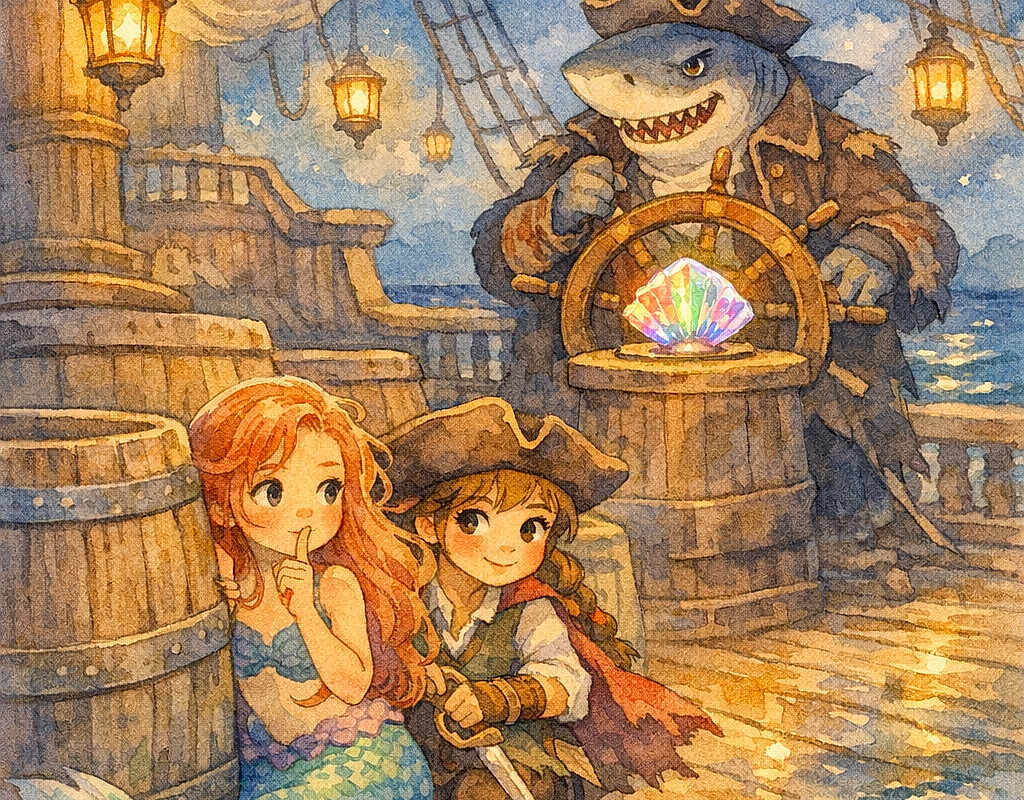
Avasorus had always thought the Coral Reef sounded like a place in a storybook: a bright maze of living towers, archways made of branching coral, and alleys where schools of fish moved like glittering ribbons. But he lived there, which meant he also knew its quieter truths—the way sand could hiss when tides shifted, the way the water tasted different before a storm, and the way some corners of the reef felt like they were listening.
He was a mermaid, though he preferred “mermaid” the way some people prefer “craftsperson” instead of “artist.” It meant work. It meant responsibility. His tail was a deep sea-green with flecks of silver like tiny, stubborn stars. He could swim fast when he had to, but he was more known for thinking first, moving second. Some called that cautious. His best friend called it “strategic.”
Avasorus was strategic because he had a secret: he didn’t love being watched. Not because he was afraid of attention exactly, but because attention always seemed to arrive with expectations—singing on command, performing tricks, solving problems instantly. If he failed, he felt the failure like a cold current under his scales.
So when the Princess arrived, glowing like a pearl in a sunbeam, Avasorus tried to slip behind a coral column and pretend he was simply examining seaweed.
“Avasorus!” she called, voice clear and warm. “Don’t hide. I can see your tail. It’s practically sparkling with guilt.”
He sighed and turned. “I wasn’t hiding. I was… conducting a very serious inspection of kelp health.”
The Princess swam closer, her long hair drifting behind her like a banner. She wore a crown that wasn’t made of gold—gold was heavy, and it looked a little silly underwater—but of polished shell and reef-stone, cleverly fitted so it caught light without blinding anyone. Her expression was lively, and her eyes held the kind of confidence Avasorus sometimes wished he could borrow for an afternoon.
“I need your help,” she said.
Avasorus waited. It was never just help; it was always an event.
She lowered her voice. “Something has been taken from the Heart Grotto.”
The Heart Grotto was not a romantic place, despite its name. It was the reef’s most important chamber: a natural cavern where the corals grew in a spiral formation around a central stone. That stone—the Reefstone—was said to help guide the reef’s currents so larvae could settle safely, so delicate creatures could find shelter, so the whole community stayed balanced.
Avasorus tried to keep his face calm. “The Reefstone is gone?”
The Princess nodded. “Not the stone itself. The Prism Shell. The one that fits over it.”
Avasorus felt the cold current in his stomach anyway. The Prism Shell was a rare, layered shell that refracted light into gentle colors. When placed on the Reefstone, it spread soft, steady illumination through the caves, like a comforting lantern. At night, it helped the younger fish and shy octopuses feel safe. In storms, it served as a beacon.
Without it, the Heart Grotto would be dim, and the reef’s inner tunnels would feel like a throat swallowing sound.
“Who would do that?” Avasorus asked.
The Princess lifted her chin. “I have a guess.”
Avasorus didn’t need her to say it. Pirates had been seen above the reef for a week—surface-dwellers in a ship that cast a long shadow. Sometimes pirates dove with heavy boots and nets, scooping up anything they considered valuable: pearls, rare shells, even living coral if they could break it off.
But this was worse. This was not just stealing something pretty. This was stealing something that helped the reef breathe.
Avasorus said quietly, “They’ll try to sell it.”
“Or use it,” the Princess said. “A Prism Shell can make light so steady it confuses creatures that navigate by glow. They could blind our scouts. They could lure others into traps.”
Avasorus swallowed. “So what do we do?”
The Princess’s smile tilted mischievous. “We get it back. Tonight.”
Avasorus stared. “Tonight?”
“Before they sail,” she said. “Tides shift at dawn. If they leave the bay, they’ll be hard to follow.”
He glanced around at the bright reef, at the busy fish and the sleepy sea cucumbers. Everything looked normal. That was the unsettling part—danger hiding in ordinary water.
“I’m not—” he started, then stopped, because he was tired of that sentence.
The Princess studied him. “You’re not what?”
He forced the words out. “I’m not brave the way you are.”
She blinked, then laughed once, not unkindly. “Avasorus, I’ve watched you negotiate with an angry moray eel and convince it to stop biting the coral gardeners. You’re brave in a way that doesn’t make a dramatic splash.”
“That moray eel was mostly hungry,” Avasorus muttered.
“Still,” the Princess said. “I need your mind. I can swim fast. I can command guards. But you notice things other people miss.” She leaned in. “Also, you make better plans than anyone. And I’d prefer not to blunder into a pirate trap with only pride and a sharp hairpin.”
Avasorus’s mouth twitched. The Princess carried a hairpin shaped like a tiny sword. She claimed it was symbolic. Avasorus suspected she just liked pretending.
“All right,” he said. “We’ll need information first.”
“Already ahead of you,” the Princess replied, and she produced something from a pouch at her waist: a small scrap of cloth.
It was blue, rough, and smelled like sun and salt.
“A sail?” Avasorus asked.
“I found it snagged on coral near the outer ridge,” she said. “Fresh tear. And look.”
She pointed to a mark on the cloth: a black symbol, crude but distinct.
Avasorus frowned. “A hooked anchor.”
“Pirate emblem,” the Princess said. “Captain Rakefin’s crew. They’re not the worst, but they’re clever.”
Avasorus didn’t like the sound of clever pirates. He preferred foolish pirates who tripped over their own greed.
He took the cloth and studied the weave. “If they dove near the outer ridge, they might have used the narrow trench. It hides you from above.”
The Princess nodded. “Exactly. So we follow the trench. You lead.”
Avasorus opened his mouth to argue, then closed it. Strategic, he reminded himself. If he led, he could choose the safer path.
They swam through the reef as the light began to soften toward evening. Coral polyps opened like tiny mouths drinking the last warmth. A few lanternfish flickered in the shadows, practicing their glow. The reef changed when the sun lowered; the bright carnival colors turned deeper, more serious, like the sea was putting on a thoughtful face.
At the trench, the water cooled. The walls rose on either side, striped with dark algae. Sound changed too—more echo, less chatter. Avasorus felt his own heartbeat like a drum.
The Princess stayed close. “Tell me what you see,” she whispered.
Avasorus slowed, scanning. He noticed a faint trail of disturbed sand, as if something heavy had been dragged. A boot, perhaps. He noticed a broken sea fan, snapped cleanly. He noticed a tiny bubble caught under a ledge—surface air. That meant divers.
“Here,” he murmured, pointing. “They came through recently.”
They followed the trail to where the trench widened into a hidden cove. Above, the surface shimmered like a moving mirror. Through it, Avasorus could see the dark underside of a boat.
The pirate ship.
Avasorus’s throat tightened. The hull looked enormous from below, a floating cliff. A rope ladder dangled into the water, and near it, two pirates in diving gear hovered clumsily, their movements heavy and awkward. One carried a net. The other held a lantern.
“Guards?” Avasorus asked.
The Princess shook her head. “I didn’t bring them.”
He stared at her. “Why not?”
She looked almost embarrassed. “If I brought guards, Captain Rakefin would know the kingdom noticed. He’d leave immediately, and he’d probably take hostages from the reef. I thought… quieter was safer.”
Avasorus felt a surge of frustration, then a realization: the Princess, for all her boldness, was trying to protect everyone. She wasn’t reckless; she was choosing risk that she could carry on her own shoulders.
“All right,” he said, forcing himself to think. “We need a way onto the ship without being seen.”
The Princess pointed toward the shadow under the hull. “There’s a gap near the stern. A drainage hole. I’ve seen fish swim through.”
Avasorus nodded, already planning. “We go in, find the Prism Shell, and leave. No hero speeches.”
“No hero speeches,” the Princess agreed solemnly.
They swam beneath the ship, into the dim space where barnacles clung like rough beads. The drainage hole was narrow. Avasorus exhaled, flattening his shoulders, and slid through. The water inside smelled stale, like old wood and spilled oil.
They surfaced in a small chamber that sloshed with each wave. Above them was a trapdoor leading into the ship.
Avasorus listened. Footsteps. Voices.
“…told you it’d fetch a fortune,” someone said.
Another voice, lower and sharper: “Not a fortune. Control. Light like that—steady light—can lead ships through fog, blind rivals, make fools think they see safe water where there’s rock.”
Captain Rakefin, Avasorus guessed. His name was famous in reef stories, usually told to scare young fish into staying close to home.
The Princess’s eyes narrowed. She made a small motion like she was about to swim straight through the trapdoor.
Avasorus caught her wrist. “Plan,” he mouthed.
She sighed, then nodded.
Avasorus looked around the chamber. There were barrels, ropes, and a pile of old cloth. He pulled a piece of sail fabric and draped it over himself like a hood, then handed another to the Princess.
“This is absurd,” she whispered.
“It’s disguise,” he whispered back. “Pirates aren’t expecting a mermaid wearing laundry.”
The Princess pressed her lips together as if to keep from laughing at the worst moment.
Avasorus climbed the ladder to the trapdoor carefully and pushed it open a crack.
The room above was a storage hold. Crates were stacked high. Lantern light swung. Three pirates stood near a table where something glimmered.
The Prism Shell.
Even in dim light, it seemed to hold a sunrise inside it.
Avasorus’s chest tightened with relief and urgency.
Now the problem was distance. The pirates were between them and the Shell.
The Princess leaned close. “I can distract them.”
Avasorus shook his head. “Distraction gets you caught.” He scanned the room. There—above the table—hung a net filled with glass floats. If the floats dropped, they would shatter and make noise, drawing pirates away.
He whispered, “We cause a sound at the far side. They run to check. We grab the Shell.”
The Princess nodded quickly.
Avasorus slipped out, staying low behind crates. His tail made movement tricky; he had to pull himself along damp boards. He hated how vulnerable he felt out of water, like a clever creature trapped in the wrong element.
He reached the far side of the hold where a stack of metal pots leaned against a beam. He nudged them, just enough.
They crashed with a clanging roar.
“Hey!” one pirate barked.
All three turned, and two rushed toward the noise.
The third stayed near the table, suspicious.
Avasorus’s plan faltered. He hadn’t counted on one staying behind.
The Princess met his eyes from behind a crate. Her expression said, Now?
Avasorus thought fast. He grabbed a small crab that had wandered onto the boards—probably stowed away—and whispered, “I’m sorry.” Then he set it down and tapped the crate beside it.
The crab, offended, raised its claws and scuttled straight into the open.
It marched toward the pirate by the table as if it owned the ship.
The pirate blinked. “What in—”
The crab pinched his boot.
The pirate yelped and hopped back, swatting. The moment was tiny, ridiculous, and perfect.
“Now,” Avasorus mouthed.
The Princess shot forward like an arrow. Avasorus followed, dragging himself as fast as he could. The Princess reached the table first, snatched the Prism Shell, and tucked it under her arm.
The pirate recovered quickly. “Thieves!” he shouted.
Another pirate turned. “In the hold!”
Chaos erupted. Footsteps pounded. Lantern light swung wildly.
Avasorus grabbed the Princess’s hand. “Back to the hatch!”
They scrambled, but pirates were already blocking the path.
Captain Rakefin appeared at the top of a stair, tall and broad, with a beard that floated slightly from damp air. His eyes were sharp as hooks.
“Well,” he said, voice amused. “Royal company. This is an expensive evening.”
The Princess lifted her chin. “Return what you stole, and leave our reef.”
Rakefin laughed. “You call it stealing. I call it collecting.” He pointed at the Prism Shell. “That glow belongs to whoever can keep it.”
Avasorus’s mind raced. They couldn’t fight pirates on a ship. They needed water.
He whispered to the Princess, “If we reach the drainage chamber, we can slip out. But we need a barrier.”
The Princess glanced around. Her gaze caught on the barrel of oil near the wall and the lantern swinging above.
“No,” Avasorus hissed, understanding her thought instantly. “Fire spreads.”
“Not fire,” she whispered back. “Smoke.”
Before he could stop her, she flicked her hairpin—tiny sword and all—at the lantern’s rope. The rope snapped. The lantern fell and rolled, flame licking.
Avasorus’s heart lurched.
The lantern hit the oil barrel. Not enough to explode, but enough to scorch and smoke. Thick gray smoke began to billow, spreading through the hold.
Pirates coughed and cursed.
“Vent it!” Captain Rakefin shouted.
In the confusion, Avasorus pulled the Princess toward the hatch. They dropped through into the drainage chamber, splashing into water.
They didn’t pause. They dove through the narrow hole and back into the sea.
The water outside felt like freedom.
But freedom was brief.
A line whistled into the water behind them—a harpoon rope, thrown from above. It splashed near Avasorus and tightened.
Avasorus twisted, barely avoiding the hook.
“Swim!” the Princess urged, clutching the Prism Shell.
They darted into the trench, but bubbles churned behind them. Pirates were diving after them.
Avasorus’s fear rose like a tide, threatening to erase logic. He forced himself to observe: pirates moved slower underwater because of their gear. But they had tools, and they were persistent.
The trench forked ahead—one path led back to the reef’s busy outer edge, full of places to hide. The other led into a darker channel that went toward the Whispering Caves, a place most reef folk avoided because sound behaved strangely there.
The Princess looked at him. “Which way?”
Avasorus made the strategic choice that felt like swallowing a stone. “Whispering Caves.”
Her eyes widened. “That’s… not the easy route.”
“No,” Avasorus agreed. “But it’s the route where the pirates will have trouble.”
They turned into the dark channel.
The water grew colder, the coral thinner, replaced by stone ridges. The entrance to the caves yawned like a mouth. As they crossed the threshold, sound changed—every fin flick echoed, every breath seemed louder.
Behind them, pirate bubbles grew closer.
Inside the cave, faint blue algae glowed along the walls, not enough to brighten, just enough to show shapes. The cave split and twisted. The Princess held the Prism Shell close, its gentle light reflecting off stone.
“Does it bother you?” Avasorus asked softly. “The echoes?”
The Princess hesitated. “I don’t like feeling… repeated. Like the cave keeps my words and throws them back at me.”
Avasorus nodded. “That’s why I brought us here.”
She frowned. “Because you wanted me uncomfortable?”
“Because the pirates will be,” he said. “And because I know these caves.”
The Princess looked surprised. “You do?”
Avasorus felt heat in his cheeks. “When I was younger, I used to come here to be alone. The echoes made it feel like I wasn’t alone, but also that nobody real could judge me.”
The Princess’s expression softened. “Avasorus…”
He kept swimming. “There’s a chamber ahead called the Tongue of Stone. If we pass it, the cave narrows so much their gear will snag.”
They rounded a corner—and found the Tongue of Stone blocked.
A rockfall had collapsed part of the passage. It wasn’t solid; water still flowed through cracks. But the opening was too small for the Princess, especially with the Prism Shell.
Avasorus’s stomach sank.
Behind them, pirate lantern light flickered in the tunnel.
The Princess’s voice tightened. “We’re trapped.”
“No,” Avasorus said, though he wasn’t sure. He pressed his hands to the rocks, feeling the current. Water slipped through a crack to the right, strong and cold, like a hidden stream.
“There,” he said. “A fissure.”
“It’s tiny,” the Princess replied.
Avasorus examined it. Too small for both of them together. Even if they squeezed, the Prism Shell might get stuck.
Pirate voices echoed closer.
Avasorus made a decision that felt like stepping off a cliff. “Give me the Prism Shell.”
The Princess clutched it. “What? Why?”
“Because I can fit,” he said. “You can’t.”
Her eyes flashed. “No. We’re not splitting up. That’s how stories go badly.”
Avasorus almost smiled despite the fear. “Sometimes stories go badly because someone refuses to adapt.” He took a breath. “Listen. If the pirates catch us, they take it anyway. If I take it through the fissure, I can bring help or circle back through another exit.”
The Princess stared at him, torn.
Avasorus added, “Trust me. For five minutes. That’s all I’m asking.”
At last she pressed the Prism Shell into his hands. Its smooth layers were cool, humming faintly with contained light.
“Five minutes,” she said, voice low. “If you abandon me, I will haunt you so fiercely the Whispering Caves will sound like lullabies.”
Avasorus swallowed. “Understood.”
He squeezed into the fissure, turning sideways, pulling with his fingers. The shell scraped stone once—his heart jumped—but it passed.
On the other side, the water rushed, pulling him into a narrow passage like an underground river. He fought to control his direction, holding the Prism Shell tight.
The passage spat him out into a wider cavern lit by pale algae. Above was a pocket of air, and along one wall was an old structure—stone steps carved into the rock, worn smooth. An ancient tunnel from long ago, perhaps.
Avasorus’s mind worked fast. If there was an air pocket, there might be a chimney-like opening to the surface. That could be dangerous, but also useful.
He listened. Faintly, through stone, he heard echoes of pirate shouts. And, more important, the Princess’s voice—steady, defiant.
Avasorus’s fear sharpened into something else: determination.
He swam to the stone steps and found, at the top, a narrow slit where water flowed out. It led back toward the reef, judging by the warmer current.
He pushed through and emerged in a hidden alcove behind a curtain of sea grass. He recognized the place—near the old bell coral, a formation that rang softly when currents hit it.
Avasorus looked up. The pirate ship’s shadow still darkened the surface in the distance.
He needed help, but not guards who would cause chaos. He needed someone fast, small, and brave.
He whistled—a sharp, patterned sound used by reef messengers.
A moment later, a group of quick silver fish appeared, their leader a sleek mullet with a scar across its nose.
“Avasorus?” the mullet asked in fish language that sounded like clicks and rushes. “You’re far from your thinking spots.”
“Urgent,” Avasorus said. “Princess is in the Whispering Caves. Pirates are near. I need a diversion at the cave entrance—something loud, confusing.”
The mullet’s eyes gleamed. “Confusing is our specialty.”
Avasorus explained quickly. The fish listened, then darted away like thrown knives.
Now Avasorus had to return to the Princess.
He swam back through the hidden tunnel, against the current this time, muscles burning. Strategic didn’t mean easy.
When he reached the fissure again, voices were louder. Pirate lantern light flickered through cracks.
He squeezed back through, heart hammering.
On the other side, the Tongue of Stone chamber was chaos. Two pirates hovered near the rockfall, trying to pry stones away. Another held a net. Captain Rakefin himself floated behind them, face twisted with irritation.
And the Princess—she was pinned against the wall, not caught, but cornered. Her hairpin-sword was clutched in her hand, and her eyes blazed.
Avasorus’s mind snapped into action.
He raised the Prism Shell. Its light spread through the water, brighter than before in the darkness of the cave. The glow hit the algae on the walls, making it flare in response, turning the cavern into a shimmering dome of blue and gold.
Every echo sharpened. Every movement flashed.
The pirates blinked and recoiled, momentarily disoriented.
Captain Rakefin narrowed his eyes. “There you are.”
Avasorus swam forward, placing himself between the pirates and the Princess.
The Princess looked shocked. “You came back.”
“Five minutes,” Avasorus said, voice shaking but steady.
Rakefin laughed. “How touching. Hand over the shell.”
Avasorus didn’t move. “You don’t understand what you took. It isn’t a trinket.”
Rakefin’s smile sharpened. “Everything valuable is a trinket until it buys you what you want.”
Avasorus felt the temptation to argue, to explain the reef’s balance, the way currents carried life. But pirates didn’t steal because they lacked information. They stole because they didn’t care.
So Avasorus did something he rarely did.
He acted without a perfect plan.
He turned the Prism Shell toward the ceiling and sang.
Not a pretty, stage-ready song. A low, resonant note that matched the cave’s natural frequency, something he had discovered by accident in his younger, lonelier days. The note vibrated through stone and water.
The algae along the walls pulsed in rhythm.
The cave responded.
A deep rumble shook the Tongue of Stone.
Small stones loosened. Water trembled.
The pirates looked around in alarm.
“What is that?” one shouted.
Avasorus kept singing, holding the note steady. His throat strained. His lungs burned. But the sound grew, amplified by echoes.
The bell coral far away—connected by water channels—began to ring faintly, as if answering.
Then, at the cave entrance, the mullet squad arrived.
They didn’t attack. They performed.
Dozens of silver fish swirled in a tight spiral, reflecting the Prism Shell’s light in blinding flashes. They darted in patterns that made it seem like the cave was filling with moving knives of light.
Pirates flailed, shielding their eyes.
Rakefin cursed. “Out! Everyone out!”
As the pirates retreated toward the entrance, Avasorus stopped singing. The rumble faded, leaving only the confused echoes.
The Princess grabbed his arm. “That was… you did that on purpose?”
Avasorus blinked, surprised at himself. “Mostly.”
They swam through the gap the pirates had left. The mullet squad continued their flashing spiral, driving the pirates backward like a wall of living mirrors.
Avasorus and the Princess slipped past, into the channel that led back to the reef.
They didn’t stop until they reached a coral archway where the water warmed and familiar scents returned—salt, sea grass, the faint sweetness of coral bloom.
Only then did the Princess slow and laugh, breathless. “Laundry disguise, crab soldier, cave-singing… Avasorus, you’re a whole disaster.”
He laughed too, the sound bubbling out of him like released pressure. “You cut a lantern into an oil barrel.”
“A strategic smoke signal,” she insisted.
They reached the Heart Grotto as night settled. The grotto was dim without the Prism Shell; shadows seemed heavier, and the Reefstone looked like a sleeping giant.
The Princess hovered above the stone, suddenly solemn. “Put it back,” she said.
Avasorus approached carefully and fitted the Prism Shell over the Reefstone.
The effect was immediate. Light spread outward in slow, gentle waves, like breathing. Colors returned to the grotto walls—soft pinks, calm blues, greens that felt like safety. The reef’s tunnels beyond seemed to glow from within, as if the whole place remembered how to be welcoming.
Avasorus felt tension he hadn’t noticed unwind from his spine.
From outside the grotto, reef folk began to gather, drawn by the returning light. Curious fish peeked in. A shy octopus clung to a rock, eyes wide. Coral gardeners arrived with their tools.
The Princess turned to Avasorus. “You saved it.”
“We saved it,” he corrected, surprising himself with how easily the words came.
She nodded. “We did.”
An elder seahorse drifted forward, slow and dignified. “Princess,” the seahorse said, then looked at Avasorus. “And you, Avasorus. Word travels fast when fear is involved. Pirates were seen fleeing in confusion, complaining that the sea itself sang at them.”
Avasorus’s cheeks warmed.
The elder seahorse continued, “The Reefstone’s light is restored. For this, the reef owes you gratitude. But gratitude alone is thin food.”
He gestured to a small chest carried by two strong triggerfish. The chest was made of waterproof wood banded with metal, and it clinked softly.
Avasorus blinked. “What is that?”
“Recovered pirate goods,” the Princess said, eyes sparkling. “While Captain Rakefin’s crew fled, our scouts found a stash they had hidden in the trench. They abandoned it.”
The triggerfish set the chest down and opened it.
Inside were treasures that made the grotto light dance: a handful of polished coins stamped with strange symbols; a necklace of sea-glass beads in every shade; a small silver compass sealed in glass; and, nestled in velvet cloth, a conch shell carved with delicate runes.
Avasorus stared at the carved conch. The runes weren’t random decoration; they were instructions.
The Princess nudged him. “Take something. Officially. As a reward.”
Avasorus hesitated. Taking treasure felt like pretending to be someone else—someone bold and entitled. But then he remembered her earlier words: expectations. Maybe he could choose an expectation that fit.
He reached for the carved conch.
“What does it do?” the Princess asked.
Avasorus traced the runes. “It’s a Resonance Shell. If you blow it—underwater, not air—it amplifies your voice in a controlled way. Not like shouting. Like… guiding sound.”
The elder seahorse nodded. “A relic from old reef guardians. It rewards those who listen to the sea.”
Avasorus held it carefully, feeling its weight. A tool. A skill made tangible.
The Princess picked up the glass-sealed compass and turned it in her hands. “And I’ll take this. It points north?”
The elder seahorse coughed politely. “It points toward the strongest magnetic pull. Which is not always north, but always interesting.”
“Even better,” the Princess said.
Avasorus looked around the grotto at the reef folk watching them. He expected to feel exposed, but instead he felt… connected. The light softened faces. The Reefstone’s glow made everyone look like part of the same story.
The Princess leaned close and whispered, “You know, you were brave.”
Avasorus frowned slightly. “I was terrified.”
“Those aren’t opposites,” she said. “If anything, they’re partners.”
He considered that. The idea didn’t erase his fear, but it made it feel less like a flaw and more like weather—something you navigate.
Outside the grotto, the reef settled into night routines. Lanternfish lit gentle pathways. Crabs patrolled with important attitudes. Far above, the pirate ship’s shadow drifted away, smaller and smaller.
Avasorus held the Resonance Shell and imagined future uses: calling for help across distance, calming panicked creatures with steady sound, perhaps even shaping echoes in the Whispering Caves into something beautiful rather than frightening.
The Princess flicked her tiny sword hairpin back into place and grinned. “Next time, we bring guards.”
“Next time,” Avasorus agreed, “we also bring a crab that volunteers.”
She laughed. “Deal.”
And in the Heart Grotto, under the Prism Shell’s returning glow, Avasorus realized he had gained more than a rescued treasure. He had gained a new skill he could practice, a relic he could use, and a proof he could keep: that his careful mind and quiet courage belonged in the reef’s brightest stories.