
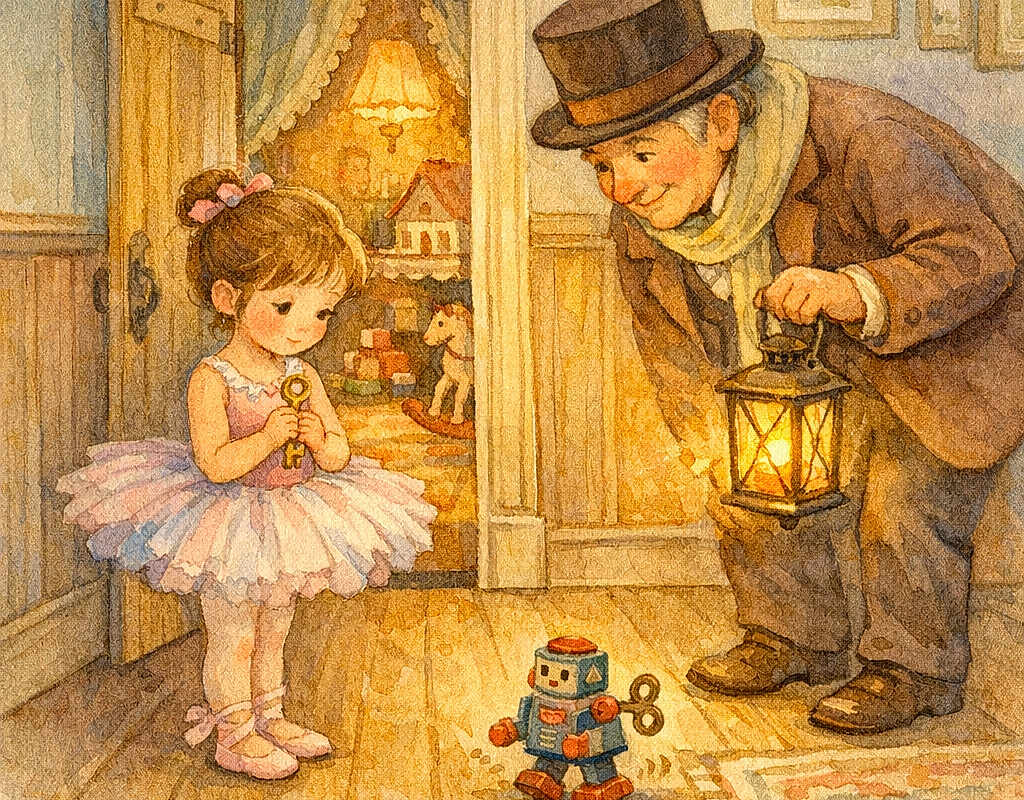
Fiorella was not the kind of ballerina who only danced on bright stages with velvet curtains. She practiced in a quiet House where the stairs creaked like old violins and the hallway mirrors seemed to hold their breath when she spun. She was small, quick, and very determined, but also secretly shy. When people watched, her toes felt like they forgot what to do. When she was alone, though, her feet told stories—soft as feathers, sharp as lightning.
Up in the House’s highest room was a studio with a smooth wooden floor and a window that poured in pale afternoon light. Fiorella called it her “sky window,” because if she stood on tiptoe, she could see the tops of distant trees and the slow, floating clouds.
In that studio lived the Headmaster.
He was not a school headmaster with a chalkboard and a bell. He was the Headmaster of the House itself: tall, tidy, always wearing a vest with too many pockets, and carrying a small notebook where he wrote down important matters like “Door hinges: squeak level, moderate” and “Fiorella: pirouettes, improving.” His eyes were kind, but he could look stern if you left crumbs on the stairs. He spoke with careful, measured words, as if every sentence needed to land like a perfect step.
“Posture, Fiorella,” he reminded her one late afternoon as she practiced a new sequence.
Fiorella’s arms lifted like swan wings. “I’m trying,” she said, cheeks warm.
“I know. Trying is a fine start,” said the Headmaster. “But today, we must do more than try. Today, we must solve a problem.”
Fiorella stopped mid-step. “A problem?”
The Headmaster opened his notebook and turned to a page with a small drawing of a key. “A very particular key. The key to the music box.”
Fiorella’s eyes widened. In the studio corner sat an old music box—beautiful, round, and painted with tiny gold stars. When it played, the House seemed to breathe in time: the curtains swayed gently, the floorboards warmed, and Fiorella could dance without fear, because the melody held her like a hand.
But for three days, the music box had been silent.
“I looked everywhere,” Fiorella said. “Under the rug, behind the mirror, even inside my practice bag.”
“Then we must look somewhere you have not looked,” the Headmaster said. “And we must do it carefully. The House has… moods.”
As if to prove his point, a far-off door in the hallway gave a tiny, offended click.
Fiorella hugged her elbows. “Is the House angry?”
“Not angry,” the Headmaster corrected. “Curious. And perhaps slightly mischievous. Which means our search must be clever.” He tapped the drawing of the key. “Your quest is to find the music box key.”
Fiorella swallowed. A quest sounded big, like something for heroes in storybooks, not for a shy dancer with scuffed slippers.
Then, from the shelf near the window, something shifted.
A Toy—an old wind-up figure with painted cheeks and stiff little arms—turned its head. It had been sitting there for years, usually harmless, usually still. But now its tiny eyes looked strangely alert.
Click.
The Toy’s mouth did not move, but a thin, squeaky voice seemed to come from inside it. “Key? Key? No music. No dancing. Better this way.”
Fiorella took a step back. “Did… did it talk?”
The Headmaster’s expression hardened, like a curtain pulled tight. “So. Toy has decided to interfere.”
The Toy’s wind-up knob twitched. “Dancing makes the House too happy,” it squeaked. “Happy makes things change. I like still. I like quiet. I like… stuck.”
Fiorella’s stomach flipped. She loved the House, even with its moods and its creaky stairs. She didn’t want it stuck. She didn’t want her own feet stuck either.
The Headmaster closed his notebook with a soft snap. “Toy, return what you took.”
The Toy tilted its head. “Find it,” it said, and with a sudden clatter, it hopped off the shelf, scampering toward the door on stiff legs that somehow moved fast.
“Hey!” Fiorella blurted, surprising herself.
The Toy vanished down the hallway, its clicking footsteps fading like impatient raindrops.
Fiorella looked at the Headmaster. “It took the key?”
“It certainly knows where it is,” he said. “And it wants to test whether you will give up.”
Fiorella’s fingers curled into her skirt. She wanted to say, I’m not brave. I’m just a ballerina. But the music box meant more than practice. It meant courage, and quiet joy, and the feeling that her heart could move freely.
“I won’t give up,” she said, voice small but steady.
The Headmaster’s sternness softened. “Good. Then we will search the House in order. Rooms first, then the hidden places.” He lifted one finger. “Rule one: watch the shadows. Rule two: listen to the floor. Rule three: when you feel afraid, use what you know best.”
Fiorella blinked. “Dance?”
The Headmaster nodded. “Balance, timing, and grace are not only for stages. Now, let us begin.”
They stepped into the hallway. The House smelled like lemon polish and old books. Sunlight lay in rectangles on the floor. Everything looked normal, but Fiorella noticed little oddities: a picture frame slightly tilted as if someone had bumped it, a ribbon on the stair rail tied into a too-neat knot.
Click-click-click.
Far ahead, the Toy’s footsteps teased them.
They checked the living room first. The sofa cushions were puffed like clouds. The fireplace was cold. The Headmaster crouched to peer under the armchair.
“No key,” he murmured.
Fiorella looked behind the curtains. Nothing but dust and a forgotten coin.
“Oh,” she said, picking it up. “A shiny!”
The Headmaster glanced over. “Keep it. Rewards matter. They help a hero remember what they accomplished.”
Fiorella slipped the coin into her pocket, surprised by the warm thrill of keeping it.
From the doorway, a squeak: “Wrong room.”
The Toy stood there, arms stretched like it was about to conduct an invisible orchestra. Then it darted away again.
They followed into the kitchen. Pots hung from hooks like sleepy bells. The Headmaster opened drawers one by one with careful patience.
Fiorella checked the cookie jar. It was empty, which felt like an insult.
“Toy,” Fiorella called, trying to sound firm. “Give the key back.”
A spoon in the drying rack trembled, as if giggling.
“No,” the Toy’s voice echoed from somewhere near the pantry. “If you dance, you might feel brave. Brave makes you try new things. New things make the House… unpredictable.”
The Headmaster straightened. “Unpredictable can also mean wonderful,” he said.
Fiorella peeked into the pantry and saw only stacked cans and a bag of rice. But on the floor, there were tiny scuff marks—stiff little footprints.
“Upstairs,” she whispered.
They climbed. The stairs complained loudly, but Fiorella stepped lightly, landing each foot as if on a stage. Halfway up, she heard the Toy ahead, click-click-click, like it was hurrying but also showing off.
At the top was Fiorella’s bedroom. It was neat in an imperfect way: books in a leaning tower, hair ribbons draped over a chair, slippers lined up like sleepy pets.
The Toy stood on the bedpost, looking proud.
“Where is it?” Fiorella asked.
The Toy’s painted cheeks seemed brighter. “If you want music, you must catch me.”
Then it leapt down, ran across the floor, and squeezed through a crack behind the wardrobe.
Fiorella rushed after it, only to stop short. The crack was dark, narrow, and definitely not supposed to be there.
“The House has hidden places,” the Headmaster said quietly, as if speaking too loudly would make them vanish. “It only shows them when it chooses.”
Fiorella touched the edge of the crack. Cold air breathed out.
“I don’t like that,” she admitted.
The Headmaster looked at her kindly. “You do not have to like it. You only have to take one careful step at a time.”
Fiorella nodded. She placed her hands on the wardrobe and pushed gently. It slid aside with a sigh, revealing a narrow door she had never seen.
The Toy’s voice drifted from beyond. “Come in. Come in. If you dare.”
Fiorella glanced at the Headmaster.
“I will be close,” he promised. “But this is your quest. Your feet must choose the path.”
Fiorella took a deep breath—one she had practiced for performances. Then she opened the narrow door.
Inside was a passageway, just wide enough for one person, lined with old wallpaper patterned with faded moons. The air smelled like cardboard and forgotten lullabies. The floor was smooth, almost like a dance floor, but it slanted slightly, as if the House was tilting its head.
Click-click-click.
The Toy ran ahead, its footsteps bouncing.
Fiorella followed, making her steps quiet and precise. She used a dancer’s trick: instead of staring at the darkness, she focused on a point ahead, a steady “spot,” like she did during turns.
The passage opened into a secret playroom.
Fiorella gasped.
It was filled with Toys—stuffed animals, wooden blocks, tiny tin cars, a dollhouse with missing windows. They were arranged in circles and lines, as if they had been practicing a strange parade. In the center sat a small pedestal made of stacked books.
On top of the pedestal, something glittered.
“The key!” Fiorella breathed.
It was the music box key—silver, curved like a question mark, with a star cutout in the handle.
But between Fiorella and the key stood the Toy, arms stretched wide like a guard.
“No dancing,” it squeaked. “No music. No change. This room stays the same.”
The Headmaster stepped into the playroom behind Fiorella. His shoes made a firm sound on the floor.
“This House is not a museum,” he said. “It is a home. Homes are meant to be lived in.”
The Toy shook its head violently. “Lived in means moved. Moved means lost. Lost means forgotten.”
Fiorella’s heart softened at that. The Toy sounded less mean and more… worried.
“You’re afraid,” she said.
The Toy froze. “I am not afraid. Toys do not feel.”
Fiorella looked around at the playroom. Some of the stuffed animals had worn patches. A few blocks were chipped. They looked like they had been loved a long time ago.
“You don’t want to be forgotten,” Fiorella said gently. “Is that why you took the key? Because the music makes everyone dance, and then the room changes, and you think you’ll disappear?”
The Toy’s wind-up knob trembled again. Its voice turned thin. “If everything is loud and happy, no one notices the quiet corner. No one notices the old Toy on the shelf. No one winds me up anymore.”
The Headmaster’s stern face melted into something sad and thoughtful. “I did not realize,” he admitted. “I have been keeping the House in order, but perhaps I have neglected its memories.”
Fiorella took one step forward. “Toy, I notice you.”
The Toy’s painted eyes flicked to her. “You notice me… now. But later?”
Fiorella thought of her own fear—how she worried people would watch her and see a mistake and decide she wasn’t worth applauding.
“I get scared of that too,” she confessed. “When I dance in front of people, I’m afraid they’ll forget me if I’m not perfect.”
The Toy made a tiny creak, as if it was listening despite itself.
Fiorella lifted her arms slowly, like she was beginning a dance. “What if we make a deal? We bring back the music, and we make sure you’re part of it.”
The Toy’s voice squeaked higher. “Part of it how?”
Fiorella’s mind raced. She remembered the Headmaster’s rule: when afraid, use what you know.
“I’ll create a show,” she said. “A real show. In the studio. You can be in it.”
The Toy wobbled. “Toys cannot be in shows. Toys are… still.”
Fiorella smiled, a little mischievous now. “Not if they’re wound up. Not if they’re brave enough to try.”
The Headmaster cleared his throat. “I can build you a proper stage,” he offered. “With a spotlight. And I can write your name in my notebook under: ‘Important residents of the House.’”
The Toy’s arms lowered a fraction. “A spotlight?”
“And,” Fiorella added, patting her pocket, “I found a shiny coin today. It can be your lucky treasure. Show treasures are important.”
The Toy stared at her pocket as if the coin was a miracle.
“But,” Fiorella said carefully, “I can’t do it without the key. The music is my courage.”
For a moment, the playroom was silent except for the slow settling creaks of the House.
Then the Toy stepped aside.
“Take it,” it squeaked, very softly. “But… you promise?”
Fiorella walked forward, each step steady like a practiced routine. She took the music box key from the pedestal. It felt cool and real in her hand.
“I promise,” she said. “You won’t be forgotten. Not in my House.”
The Toy’s shoulders sagged with relief, as if it had been holding up a heavy thought for a long time.
On the way back through the passage, the House seemed less cold. The wallpaper moons looked brighter, like they were waking up. Even the slanted floor felt more like a slide than a trap.
When they reached the studio, Fiorella hurried to the music box. Her fingers trembled a little as she fit the key into place.
The Headmaster stood nearby, hands clasped behind his back, watching with a careful hope.
The Toy lingered in the doorway, half-hidden.
Fiorella turned the key.
At first, nothing.
Then: a tiny chime. A soft, clear note like a drop of water in a quiet pond. The melody began to unfold, familiar and warm.
The House answered.
Somewhere downstairs, a door stopped clicking. The curtains lifted as if breathing in. The wooden floor under Fiorella’s feet felt steady, ready.
Fiorella’s shoulders loosened. “It’s back,” she whispered.
The Headmaster nodded once, pleased. “Well done.”
Fiorella turned toward the Toy. “Now it’s your turn.”
The Toy hesitated. “I will look silly.”
Fiorella tilted her head. “So will I, sometimes. But we can be silly together.”
The Headmaster stepped forward and opened one of the pockets on his vest. He pulled out a small brass wind-up key—just the right size.
“I keep this for emergencies,” he said. “I believe this qualifies.”
The Toy’s eyes widened. “For me?”
“For you,” the Headmaster confirmed. He knelt and gently wound the Toy, careful not to scrape the paint.
The Toy shivered, then stood straighter, as if energy had filled its joints.
Fiorella clapped once. “Welcome to the show.”
They set to work. The Headmaster, precise and clever, moved a few chairs to create a little audience row. He draped a scarf over a lamp to make a golden spotlight. He even taped a paper sign to the door that said: TONIGHT: FIORELLA AND TOY.
Fiorella found ribbons from her drawer and tied one around the Toy like a tiny sash.
“I look… important,” the Toy said in awe.
“You are,” Fiorella replied.
When everything was ready, Fiorella stood in the center of the studio. The music box played its gentle melody, looping like a friendly whisper. The Headmaster sat in the front chair, notebook open, ready to record.
The Toy stood at the side, knees trembling.
Fiorella began to dance.
She started with small steps, letting the music warm her up. Then she grew bolder—turns, leaps, and a graceful sweep of her arms that made her feel as if she was drawing light in the air.
The House seemed to watch through every mirror and window, but this time Fiorella did not shrink. The melody held her steady.
Halfway through, she nodded at the Toy.
“Now,” she whispered.
The Toy marched forward on its stiff legs. It did not glide like Fiorella. It did not leap. It marched and clicked and made a brave little circle.
At first, it looked awkward.
Then it did something unexpected: it bowed.
The bow was deep and dramatic, as if it had practiced in secret.
Fiorella laughed—a real laugh, light and delighted.
The Toy blinked, surprised by the sound. “Was that… good?”
“That was amazing,” Fiorella said.
The Headmaster cleared his throat loudly, though his eyes shone. “Ahem. Official note: Toy’s bow achieved ‘very charming’ status.” He scribbled quickly.
The Toy puffed up with pride. “Very charming,” it repeated as if tasting the words.
Fiorella finished the dance with a final spin and a strong, steady stop. She held her pose, chin lifted. For one second, she felt the old fear—that she would wobble, that she would be judged.
But the House was quiet in a comfortable way. The music box chimed softly. The Headmaster clapped, slow and sincere.
The Toy clapped too, its stiff hands tapping together with determined enthusiasm.
Fiorella relaxed, smiling.
“You did it,” the Headmaster said, standing. “You recovered the key, and you restored the melody.”
Fiorella looked at the Toy. “And you joined the music.”
The Toy’s voice was small now, no longer sharp. “I thought stillness would keep me safe. But… being part of the show feels better.” It glanced at the paper sign on the door. “My name is on it.”
Fiorella reached into her pocket and pulled out the shiny coin. “And this is your lucky treasure,” she said, placing it carefully into the Toy’s tiny palm.
The Toy stared at it as if it were a moon. “Mine?”
“Yours,” Fiorella confirmed. “To remind you you’re noticed.”
The Headmaster nodded approvingly. “A proper reward. A token of belonging.”
The Toy held the coin tightly. “Then I will not hide keys anymore,” it promised. “I will… help.”
Fiorella tilted her head. “Help how?”
The Toy looked around the studio, thinking hard. “When you feel shy, I can stand by the door like a guard,” it said. “If fear tries to come in, I will click at it.”
Fiorella giggled. “That’s the best plan I’ve heard all week.”
The Headmaster closed his notebook. “Then it is settled. The House will have music again, and every resident—old and new—will have a place.”
As evening settled outside the sky window, the studio glowed warmly. The music box continued its gentle tune. Fiorella practiced one more sequence, and this time, she did it with the Toy watching proudly and the Headmaster counting softly.
When she finished, Fiorella felt something new inside her—not loud, not flashy, but sturdy.
It was the feeling that courage could be built, step by step, like a dance.
And in the corner, under the golden lamp-scarf spotlight, the Toy stood with its shiny coin and its little ribbon sash, looking less like an antagonist and more like a friend who had finally found its place in the House.